
Medical device illustration is a specialized discipline of biomedical visualization that produces scientifically accurate, technically detailed graphic representations of medical hardware – including implants, surgical instruments, diagnostic equipment, combination products, and delivery systems – for use across regulatory submissions, marketing collateral, training documentation, and clinical communication. A professionally executed medical device illustration translates complex three-dimensional mechanical and anatomical relationships into clear, purposeful visuals that accelerate stakeholder comprehension at every phase of a device’s commercial lifecycle. For MedTech companies operating in FDA-regulated or CE-marked markets, the quality and precision of these visuals directly shapes regulatory outcomes, sales conversion rates, and end-user safety.
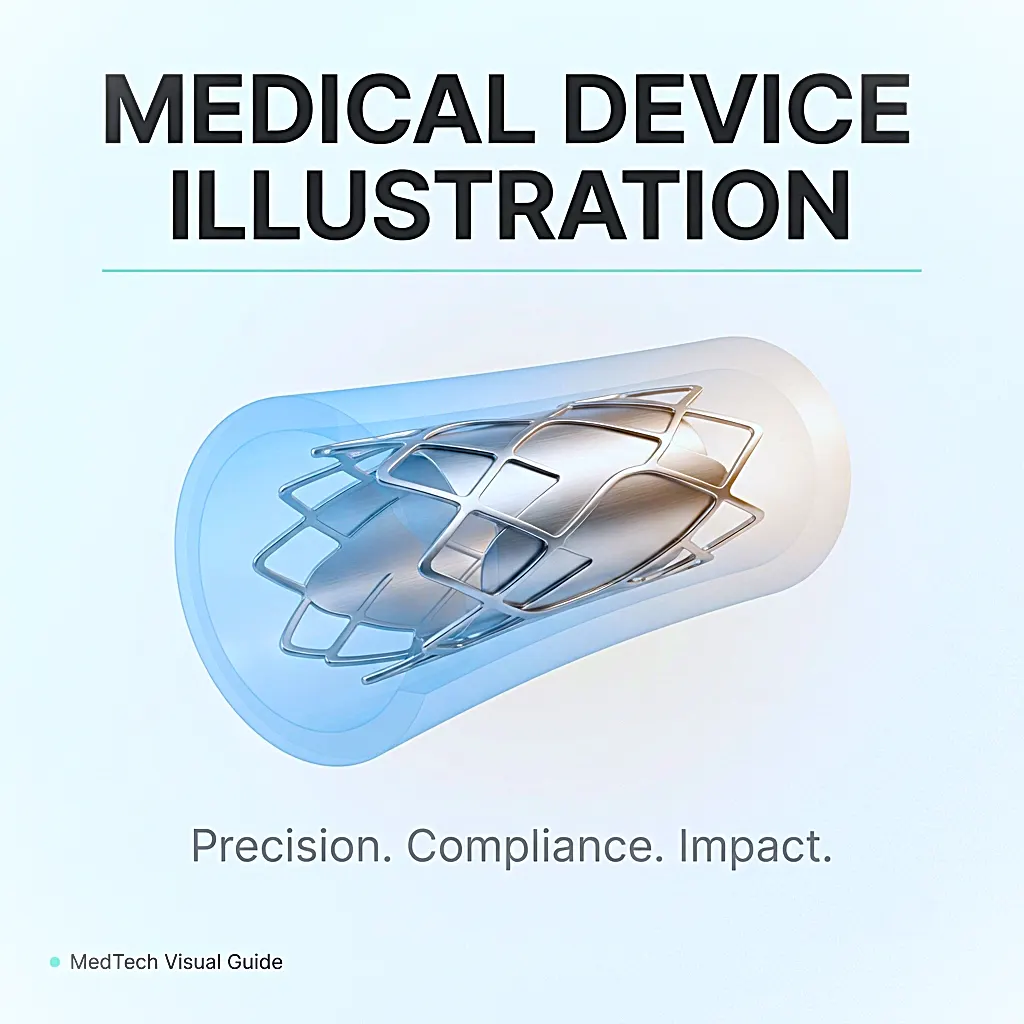
Whether you are preparing a 510(k) submission, launching a product at a medical trade show, or building a surgical training curriculum, the visual content you produce is inseparable from your commercial and clinical success. Poor illustration – anatomically inaccurate, technically vague, or stylistically inconsistent – damages credibility in front of regulators, surgeons, and investors alike.
This guide covers everything a MedTech company needs to know about medical device illustration: what it is, why it matters, how it is used across the full device lifecycle, what types are available, and how to commission work that delivers measurable results.
If your team is looking for end-to-end custom medical device illustration and photorealistic 3D medical product visualization services, The Medical Illustration Company delivers studio-quality assets at competitive rates with unlimited revisions and full copyright transfer.
What is Medical Device Illustration? A Precise Definition
Medical device illustration sits at the intersection of biomedical science, precision engineering drawing, and commercial visual communication.
Unlike standard product rendering, a medical device illustration must satisfy three distinct and simultaneous demands:
- Scientific accuracy – The device must be depicted with anatomically and mechanically correct proportions, material properties, and deployment geometry.
- Regulatory clarity – Illustrations used in Instructions for Use (IFU) documents, 510(k) submissions, or CE technical files must meet specific formatting and labeling standards.
- Audience-specific communication – The same device often requires multiple illustration styles: a photorealistic render for a surgeon’s brochure, an exploded-view line drawing for a service manual, and a mechanism-of-action sequence for an investor presentation.
Medical illustrators who specialize in device work combine graduate-level biomedical visualization training with deep familiarity with engineering CAD conventions, ISO 15223-1 device symbols, and the regulatory documentation requirements of clinical, commercial, and compliance audiences.
According to the Institute of Medical Illustrators (IMI), professional medical illustrators are specifically trained to translate technically complex biomedical subjects into visuals that serve the exact communication purpose at hand – whether that is patient education, regulatory documentation, or commercial marketing.
Quick Answer for Featured Snippets: Medical device illustration is the creation of scientifically accurate visual depictions of medical hardware – implants, instruments, diagnostics, and delivery systems – used in FDA submissions, IFU documents, marketing materials, investor presentations, and clinical training programs. It requires both biomedical expertise and advanced illustration skills.
Why MedTech Companies Need Medical Device Illustration
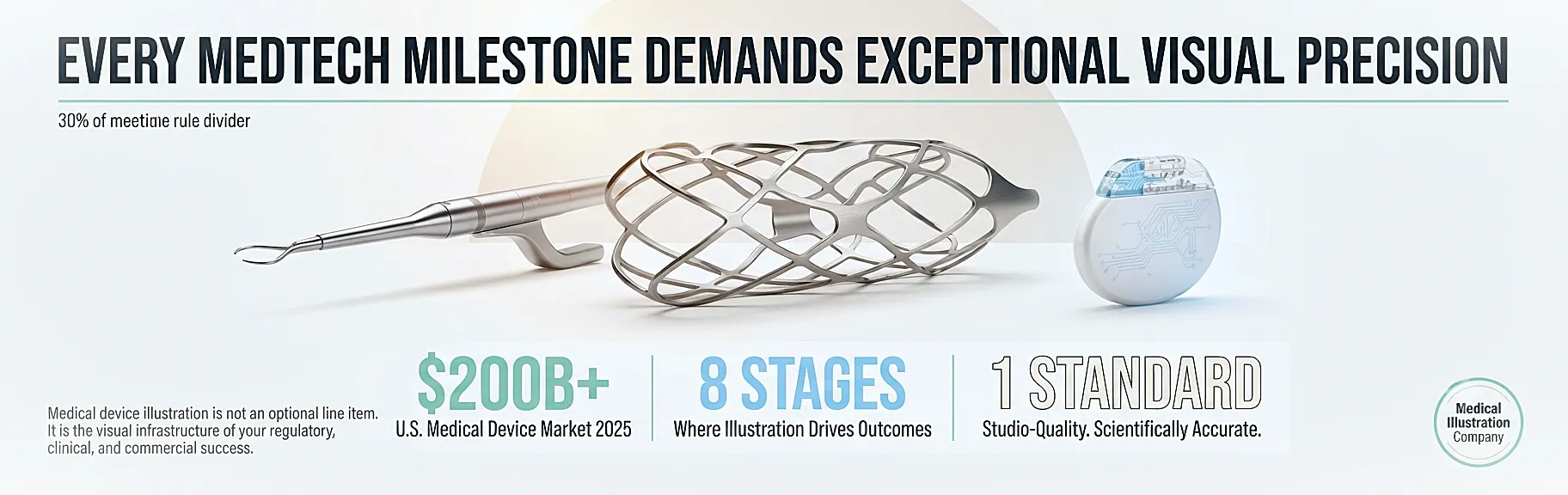
The global medical device industry is one of the most communications-intensive regulated sectors in the world. With the U.S. medical device market alone valued at over $200 billion in 2025 and expanding rapidly, the pressure on MedTech companies to communicate device value clearly – and compliantly – has never been greater.
Here is precisely why high-quality medical device illustration is a strategic asset, not an optional line item.
Regulators Require Visual Documentation
The FDA’s Center for Devices and Radiological Health (CDRH) requires that 510(k) and PMA submissions include detailed device descriptions, frequently accompanied by dimensional drawings, labeled diagrams, and use-context illustrations. Inadequate illustrations are a documented and common source of deficiency letters – which cause costly submission delays.
European MDR and IVDR technical documentation requirements equally mandate device diagrams that clearly communicate intended use, component architecture, and safety-critical features.
Surgeons and Clinicians Decide Based on Visual Clarity
When a clinical specialist evaluates a new orthopedic implant, cardiovascular catheter, or minimally invasive instrument, they need to understand instantly: how it deploys, where it interfaces with anatomy, and how it differentiates from incumbent devices. A precisely rendered medical device illustration communicates all of this in seconds.
Sales representatives equipped with high-quality device visuals consistently outperform those relying on verbal descriptions or low-resolution generic imagery.
Investors Respond to Visual Credibility
MedTech pitch decks live or die on their ability to communicate complex technology to non-specialist audiences. A clear mechanism-of-action illustration – showing the device’s interaction with target anatomy across a step-by-step visual sequence – builds trust and accelerates funding decisions. Generic stock imagery cannot perform this function.
IFU Documentation Requires Precision-Level Illustration
Instructions for Use documents are a regulatory requirement for virtually every medical device sold in regulated markets. These documents must include step-by-step visual guidance that is unambiguous, scalable across languages, and compliant with ISO and FDA labeling requirements.
A single poorly illustrated IFU step can lead to use error, adverse events, and product liability exposure. That is not a hypothetical risk – it is an active enforcement area for regulators.
For a broader understanding of why visual communication is foundational across the healthcare sector, the overview of the importance of medical illustrations in clinical and commercial contexts is a useful reference.
Key Applications of Medical Device Illustration Across the MedTech Lifecycle
Medical device illustration is not a single deliverable. The type, style, and technical specification of an illustration depends directly on where in the device lifecycle it will be used.
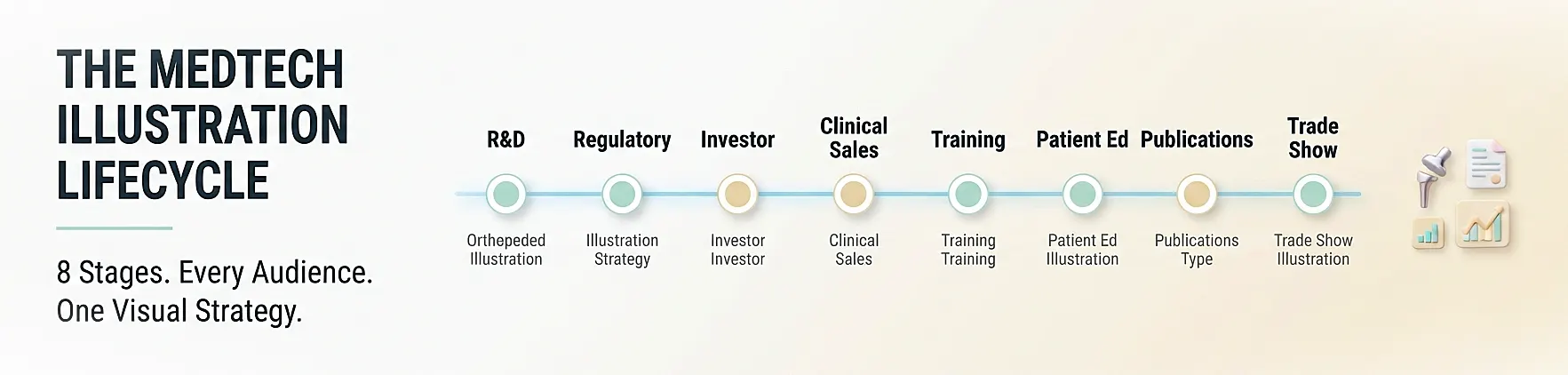
Application Table: Illustration Type by Lifecycle Stage
| Lifecycle Stage | Illustration Type | Primary Audience |
|---|---|---|
| R&D and Concept | Conceptual 3D render, CAD-based visualization | Internal engineering teams, clinical advisors |
| Regulatory Submission | Labeled dimensional diagram, IFU illustration, technical line drawing | FDA, Notified Bodies, regulatory affairs |
| Investor and Fundraising | Mechanism-of-action sequence, cross-section render | VCs, angel investors, board members |
| Clinical Sales | Photorealistic 3D render, comparative anatomy diagram | Surgeons, interventionalists, procurement |
| Surgical Training | Step-by-step procedural sequence, exploded view, annotated diagram | Clinical staff, sales trainers |
| Patient Education | Simplified anatomy-device interaction, procedure overview | Patients, caregivers |
| Publications and IP | Technical cutaway, patent application drawing | Journal reviewers, patent examiners |
| Trade Show and Marketing | Hero product render, lifestyle anatomy scene, interactive 3D asset | HCPs, hospital administrators, KOLs |
Types of Medical Device Illustration
Understanding the available illustration formats helps MedTech teams specify exactly what they need – rather than receiving a generic deliverable that misses its intended communication purpose.
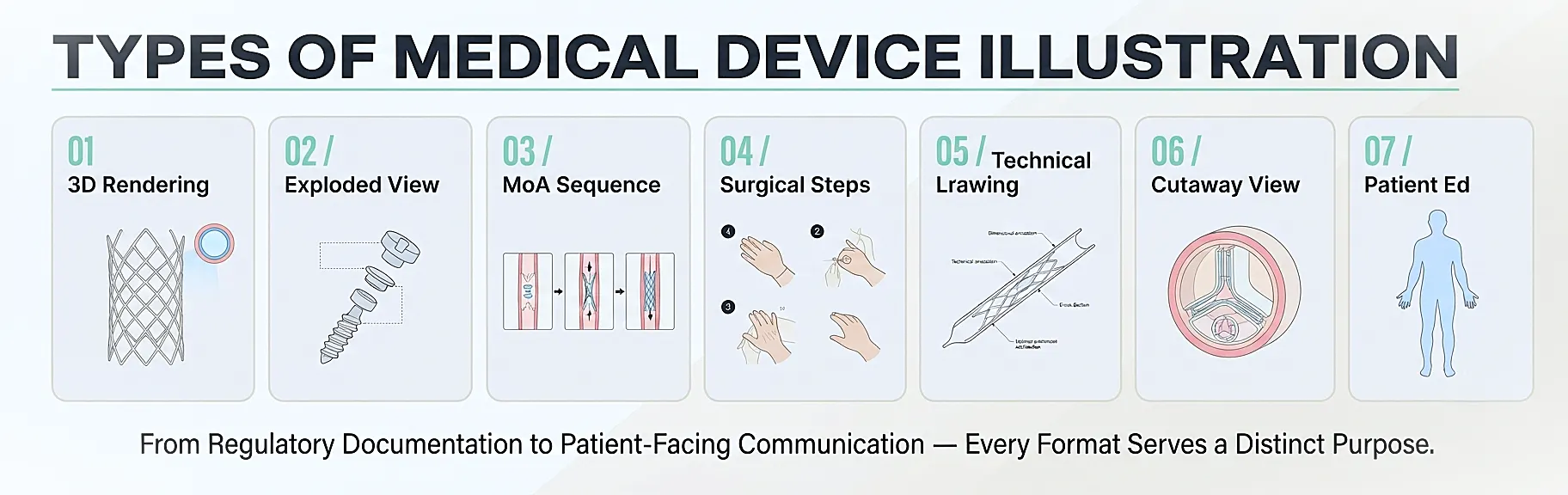
Photorealistic 3D Medical Device Rendering
Photorealistic rendering produces a studio-quality visual from a fully modeled 3D representation of the device, complete with material textures, reflections, and environmental lighting. These are ideal for marketing collateral, conference posters, website imagery, and investor presentations where the device needs to communicate premium quality at a glance.
For teams unfamiliar with the production process behind 3D visualization, this detailed breakdown of what 3D medical illustration involves and how it is produced provides a clear operational overview.
Exploded View and Assembly Diagrams
Exploded views separate all device components spatially, showing clearly how individual parts relate to each other and to the assembled whole. These are standard in service manuals, IFU documentation, and regulatory technical files where component identification and disassembly guidance are critical.
Mechanism-of-Action Sequence Illustrations
A mechanism-of-action (MoA) sequence shows the device interacting with target anatomy across multiple panels, typically following a deployment or procedural workflow. These are the highest-value visuals for investor presentations and clinical sales enablement because they communicate the “what, where, and how” of device function without requiring a verbal explanation from the presenter.
Surgical Technique and Procedural Step Illustration
Sequential surgical illustration documents each step of a procedural workflow: instrument approach, tissue interaction, device deployment, and post-placement anatomy. Surgical educators and clinical affairs teams rely on these for training programs and simulation curriculum development.
For MedTech companies building educational resources, the use of medical illustrations in clinical training videos and programs demonstrably improves knowledge retention and procedural accuracy among clinical staff.
Technical and Dimensional Line Drawing
Clean technical line drawings – produced to CAD-equivalent standards – document device geometry with precision dimensions, tolerance callouts, and material designations. These are required in patent applications, regulatory submissions, and design history files.
Cross-Section and Cutaway Illustration
Cross-sectional illustrations reveal internal device architecture: the lumen geometry of a catheter, the locking mechanism of an orthopedic anchor, or the electrode configuration of a neuromodulation implant. These are invaluable for demonstrating design innovation to technical reviewers and regulatory specialists who need to understand structural differentiation.
Patient-Facing Educational Illustration
Simplified, jargon-free illustrations explain to patients what a device is, where it will be placed, and what the procedure involves. These reduce patient anxiety, improve informed consent quality, and support value-based care documentation requirements under contemporary healthcare delivery models.
The Medical Device Illustration Process: Step by Step
Commissioning a medical device illustration from a professional studio follows a predictable workflow. Understanding each stage helps MedTech teams plan timelines, prepare reference materials, and avoid the revision loops that inflate costs.
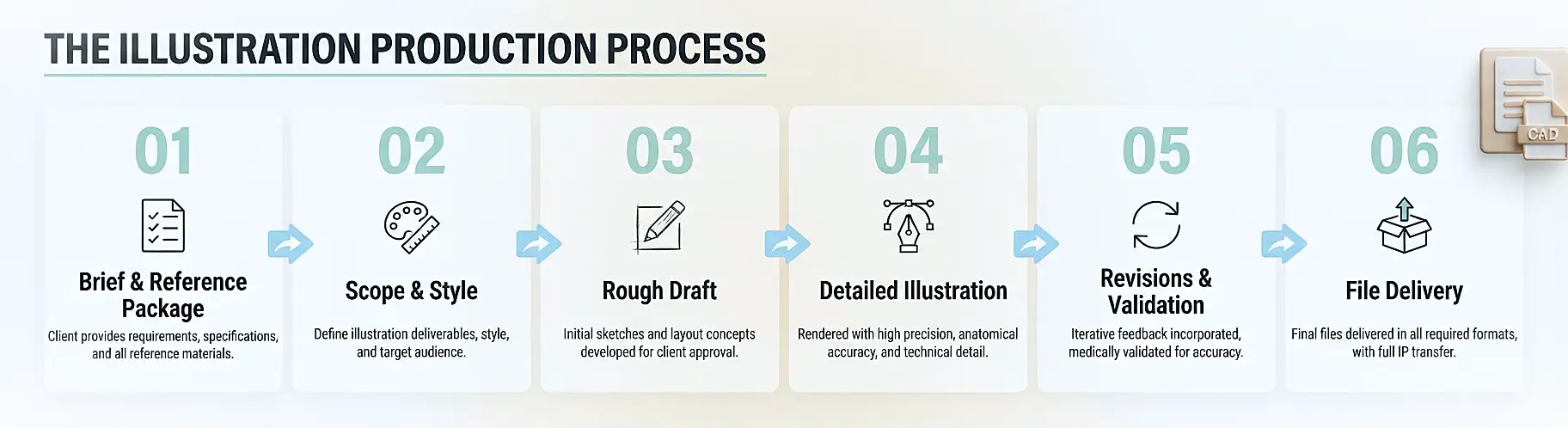
Step 1: Brief and Reference Package
The process begins with a detailed brief covering device specifications, intended use context, target audience, deliverable format requirements, and all available reference material – CAD files, engineering drawings, clinical photographs, and competitive device imagery. The more comprehensive the reference package, the faster and more accurate the first draft will be.
Step 2: Scope and Style Definition
The illustrator and client align on illustration style (photorealistic, technical line, or diagrammatic), the level of anatomical context required, the color palette and brand standards, and the file output specifications (vector EPS, high-resolution TIFF, layered PSD, or 3D-ready formats such as OBJ or FBX).
Step 3: Initial Concept and Rough Draft
A rough sketch or low-resolution conceptual draft establishes composition, device perspective, and anatomical positioning before any detailed rendering begins. This step saves significant revision time and budget downstream.
Step 4: Detailed Illustration and Annotation
The illustrator develops the full illustration: precise device geometry, anatomical relationship rendering, callout labeling, and any procedural sequence panels. At this stage, a clinical accuracy review by the client’s clinical affairs team or a consulting clinician is essential for regulatory-destined assets.
Step 5: Revisions and Scientific Validation
Client feedback and clinical reviewer notes are incorporated through structured revision rounds. A professional studio offers unlimited revisions until the illustration satisfies all accuracy, regulatory, and stylistic requirements.
Step 6: File Delivery and IP Transfer
Final assets are delivered in all agreed formats, with full intellectual property ownership formally transferred to the MedTech company. Full copyright transfer – not a usage license – should be the contractual baseline for all commissioned device illustration work.
What Separates a High-Quality Medical Device Illustration from a Generic Rendering
The difference between a studio-quality device illustration and a generic rendering is visible, measurable, and commercially consequential.
- Anatomical integration accuracy: A high-quality illustration positions the device precisely within correct anatomical geometry, scaled accurately relative to surrounding tissue. Generic renders routinely place devices in anatomically implausible positions that undermine clinical credibility.
- Material fidelity: Titanium, PEEK polymer, braided stainless steel mesh, and hydrophilic coatings each have distinct visual properties. A skilled device illustrator renders these accurately, communicating material innovation visually rather than relying solely on text descriptions.
- Regulatory-grade labeling: Illustrations destined for IFU documents or regulatory technical files require ISO-compliant callout styles, specific minimum text sizes, and clean leader line conventions. This precision requires experience with regulatory documentation formatting, not just artistic competence.
- Audience-appropriate abstraction level: Patient-facing educational illustrations require a very different level of anatomical and mechanical detail than surgeon-facing procedure guides. A qualified medical device illustrator calibrates complexity to the specific viewer without being instructed to do so.
Common Mistakes MedTech Companies Make with Device Illustration
Avoiding these errors will save budget, time, and regulatory complications:
- Using generic stock renders – Stock medical device imagery rarely depicts your specific device accurately, and using it in regulatory submissions creates material misrepresentation issues with regulators.
- Skipping clinical review – Illustrations that have not been reviewed by a clinician familiar with the relevant procedure represent a liability. Anatomical inaccuracies in IFU documents can constitute a labeling non-conformance.
- Specifying only one output format – A photorealistic PNG is unusable in a regulatory technical file that requires vector line drawings. Always specify all required output formats at the brief stage.
- Omitting anatomical context – A device shown in isolation communicates far less than one shown within its deployment anatomy. Illustrators need clear reference for the target anatomical environment, not just the device geometry.
- Confusing illustration with animation – These are distinct deliverables with different production workflows, timelines, and budgets. This breakdown of how medical illustration and medical animation differ from each other clarifies the distinction and helps teams plan appropriately.
- Treating illustration as a last-minute task – The best MedTech illustration programs begin during R&D, not at product launch. Early visualization supports patent applications, clinical advisor alignment, and investor presentations long before commercial launch activities begin.
Expert Tips for MedTech Teams Commissioning Device Illustrations
These recommendations come directly from working with device companies across the cardiovascular, orthopedic, neuro-intervention, and diagnostics segments:
- Provide CAD files wherever possible – Even non-final geometry is more useful than photographs or verbal descriptions. It allows the illustrator to build accurate geometry from the first draft.
- Define the communication goal before specifying format – Start with “we need a surgeon to understand deployment in 30 seconds” and work backwards to the illustration type, rather than starting with a format request.
- Involve your clinical affairs team in the accuracy review – They will catch errors that your marketing team will not. One review cycle before finalization is far less costly than a post-submission deficiency letter.
- Plan for a visual asset family, not a single illustration – A well-planned illustration program produces a coherent library: full device render, exploded view, mechanism-of-action sequence, and IFU steps, all with consistent style and branding across all materials.
- Specify the regulatory destination upfront – Illustrations for 510(k) submissions have different format requirements than those for MDR technical documentation files or Japanese PMDA submissions. Inform your illustrator exactly where each asset will be used.
- Require full copyright transfer in your contract – Do not commission work that remains owned or co-owned by the studio. Full IP ownership on delivery is the professional standard for commercial illustration engagements.
Medical Device Illustration vs. Generic 3D Product Rendering: Comparison Table
| Criteria | Medical Device Illustration | Generic 3D Product Rendering |
|---|---|---|
| Scientific accuracy | Anatomically validated by biomedical professionals | Not medically verified |
| Regulatory suitability | Suitable for IFU, 510(k), and MDR submissions | Not suitable for regulatory files |
| Anatomical context | Standard – in-situ views are core deliverables | Rarely included |
| Audience calibration | Tailored per audience (clinical, patient, investor) | Single generic output style |
| Illustrator qualification | Biomedical training combined with illustration expertise | Commercial design background only |
| Revision standard | Unlimited rounds including clinical review cycles | Typically limited contracted revisions |
| IP ownership | Full transfer on delivery is standard | Often license-based with restrictions |
| Application range | Marketing, regulatory, training, education, IP | Marketing collateral only |
Frequently Asked Questions About Medical Device Illustration
What is medical device illustration? Medical device illustration is a specialized discipline of biomedical visualization that produces scientifically accurate, technically detailed graphic depictions of medical hardware – including implants, surgical instruments, diagnostics, and combination products. These illustrations are used in regulatory submissions, IFU documentation, marketing materials, investor presentations, and clinical training programs. The discipline requires illustrators trained in both biomedical science and visual communication.
How is medical device illustration different from standard product photography? Product photography captures how a device looks in a controlled studio environment. Medical device illustration, by contrast, can depict the device in anatomical context inside a patient’s body, in cutaway cross-section, or as an exploded assembly diagram – visuals that photography fundamentally cannot produce. Illustration is also format-flexible, infinitely scalable, and fully revisable without a re-shoot.
What types of medical devices can be illustrated? All device classifications can be depicted through illustration: Class I consumables, Class II instruments (cardiovascular catheters, orthopedic fixation systems, ophthalmic surgical tools), and Class III implantable devices (cardiac rhythm management devices, neurostimulators, vascular prostheses). Combination products incorporating a drug or biologic component can also be depicted with mechanism-of-action illustration sequences.
How long does a medical device illustration take to produce? Timeline depends on device complexity and the number of illustration panels required. A single photorealistic 3D device render typically requires 5-10 business days. A full IFU illustration sequence covering 8-12 procedural steps typically requires 2-4 weeks. A comprehensive mechanism-of-action package with multiple anatomy integration panels can take 3-6 weeks depending on the number of revision cycles.
What file formats are delivered for medical device illustration? For regulatory and high-resolution print use: TIFF at 300 DPI minimum, vector PDF, or layered EPS. For digital and web use: optimized PNG and JPEG. For interactive or 3D-embedded application use: OBJ, FBX, or GLTF formats. Always specify all required output formats during the initial brief stage to avoid format conversion delays on delivery.
Can medical device illustrations be used in FDA submissions? Yes. Properly formatted medical device illustrations are routinely used in 510(k) submissions, PMA applications, De Novo requests, and post-market surveillance documentation. They must meet the specific formatting requirements set out in FDA guidance documents, including clear labeling, dimensional accuracy, legible annotation at the required print scale, and compliant use of ISO 15223-1 device symbols where applicable.
How much does medical device illustration cost? Pricing scales with complexity, number of panels, anatomical detail level, and output format requirements. Simple labeled device diagrams can begin from under $100. Comprehensive 3D mechanism-of-action sequences with multiple anatomical context panels typically range from several hundred to several thousand dollars depending on studio rates, revision scope, and delivery timeline. The Medical Illustration Company offers highly competitive rates without compromising on quality or scientific accuracy.
Medical Device Illustration Is a Commercial and Regulatory Imperative
Medical device illustration is one of the highest-leverage investments a MedTech company can make across its operational lifecycle. It compresses complex device science into immediately comprehensible visuals that work simultaneously for regulators, surgeons, investors, and patients. It reduces deficiency letters in regulatory submissions, accelerates clinical adoption, strengthens fundraising credibility, and protects companies from IFU-related adverse event liability.
The field is technically demanding. It requires illustrators who understand biomedical anatomy, device mechanics, regulatory documentation standards, and the distinct visual communication needs of each audience. Generic product rendering agencies and AI-generated device imagery cannot replicate what a qualified medical device illustrator delivers.
For teams building a stronger foundation in how biomedical visualization supports clinical and commercial communication more broadly, the comprehensive guide to medical illustration provides the full context for how this discipline operates across all its specializations – from anatomical education to clinical research publishing.
If your MedTech company is preparing a regulatory submission, planning a product launch, building a surgical training curriculum, or developing investor presentation assets, the quality of your device illustration directly determines your outcomes.
Commission your medical device illustrations with The Medical Illustration Company today – and receive studio-quality, scientifically accurate, revision-unlimited device visuals delivered at a fraction of typical agency rates, with full copyright ownership on delivery.