
Medical illustration turnaround time typically ranges from 3 to 10 business days for a single static piece, 1-3 weeks for 3D medical illustrations, and 4-8 weeks for full animation sequences. Project complexity, revision rounds, and reference availability are the primary variables that shift these timelines. Anyone planning a publication, pitch deck, training module, or patient education campaign needs this number early, because it directly affects launch dates, conference deadlines, and budget approvals.
Working with a dedicated medical illustration company that has an established production pipeline is one of the most reliable ways to keep these timelines predictable, since established studios already have the scientific review, art direction, and revision workflows mapped out before your project even starts.
This guide breaks down exactly what shapes medical illustration turnaround time, what to expect at each stage of production, and how to avoid the most common delays that catch first-time clients off guard.
Medical Illustration Turnaround Time
What is Medical Illustration Turnaround Time?
Medical illustration turnaround time refers to the total number of business days or weeks between the moment a project brief is approved and the moment the final, print-ready or digital-ready file is delivered to the client. It includes every stage of production: concept sketches, scientific accuracy review, color rendering, client feedback rounds, and final file preparation.
Importantly, turnaround time is rarely a single fixed number. Instead, it is a range that depends on several interconnected factors, which is why studios often provide an estimated window rather than a guaranteed date during the initial quote stage.
Average Medical Illustration Timelines by Project Type
Because “medical illustration” covers everything from a single anatomical diagram to a full 3D animated surgical sequence, timelines vary significantly by format. The table below offers a realistic baseline for planning purposes.
| Project Type | Typical Turnaround Time | Key Production Stages |
|---|---|---|
| Single 2D medical illustration (line art or color) | 3-7 business days | Sketch, review, color rendering, final delivery |
| Detailed clinical illustration (surgical, pathology) | 5-10 business days | Research, sketch, accuracy review, rendering, revisions |
| 3D medical illustration (single render) | 1-3 weeks | Modeling, texturing, lighting, rendering, revisions |
| Illustration series (5-10 images) | 2-4 weeks | Concept development, batch production, consistency review |
| Medical animation (30-60 seconds) | 4-8 weeks | Storyboard, modeling, animation, sound, final edit |
| Patient education infographic set | 1-2 weeks | Content layout, illustration, typography, branding |
5 Key Factors That Affect Medical Illustration Turnaround Time
While the table above offers a useful baseline, several variables can push a project toward the faster or slower end of each range. Understanding these factors helps clients plan realistic deadlines from the start.
1. Complexity of the Subject Matter
A simple cross-sectional diagram of an organ takes considerably less time than a multi-layered surgical illustration showing instruments, tissue planes, and anatomical landmarks simultaneously. Highly technical subjects, such as 3D medical illustrations built from CT or MRI data, naturally require more modeling and accuracy verification time.
2. Availability of Reference Material
Illustrators rely heavily on accurate reference: surgical photos, anatomical atlases, clinical descriptions, or even direct input from a physician. When clients can supply this material upfront, illustrators skip lengthy research phases. Conversely, projects involving rare conditions or novel medical devices may require additional research time before sketching even begins.
3. Number of Revision Rounds
Most professional quotes include two to three rounds of revisions. However, scattered feedback delivered across multiple emails, or feedback that arrives weeks after the initial sketch was sent, can quietly double a project’s timeline. Consolidated, clear feedback is one of the fastest ways to keep a project on schedule.
4. Illustration Style and Format
A flat, vector-style diagram intended for a slide deck renders faster than a photorealistic 3D illustration intended for a journal cover. Similarly, illustrations delivered in AI or EPS vector formats for print publications sometimes require additional file preparation compared to standard web-ready JPG or PNG exports.
5. Scientific Accuracy and Regulatory Review
Illustrations intended for peer-reviewed journals, regulatory submissions, or pharmaceutical marketing often pass through an internal scientific accuracy check, and sometimes a client-side medical or legal review as well. While this step adds time, it is essential for maintaining credibility, particularly for content following journal author guidelines for medical illustrations.
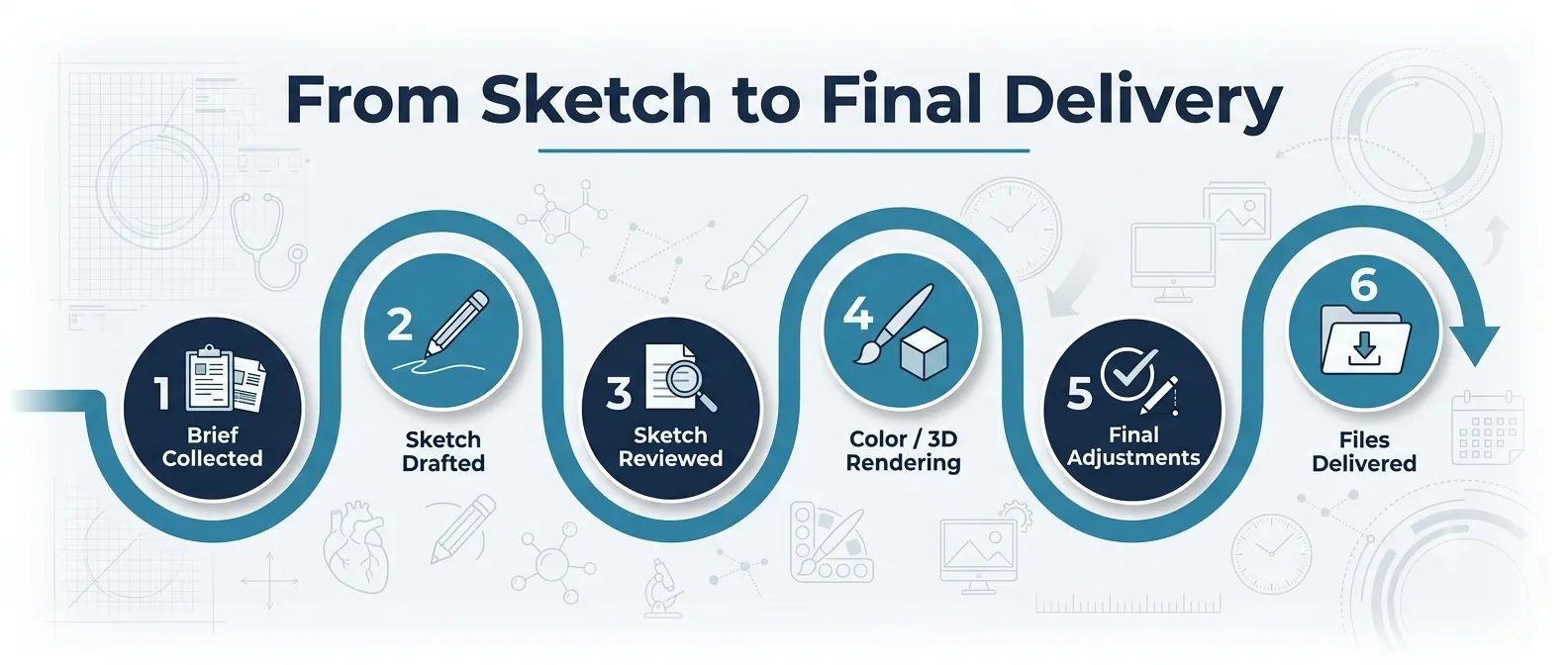
Step-by-Step: What Happens During a Typical Medical Illustration Project
Understanding the production stages helps clients see exactly where time is allocated, and where they can help speed things along.
- Brief and Reference Collection (Day 0-1): The client shares project goals, target audience, references, and brand or journal formatting requirements.
- Concept Sketch (Day 1-3): The illustrator produces a rough black-and-white sketch establishing composition, perspective, and labeling.
- Sketch Review (Day 3-4): The client reviews the sketch and provides consolidated feedback on accuracy, layout, and labeling.
- Color Rendering or 3D Build (Day 4-8): Once the sketch is approved, the illustrator moves into full color rendering, or for 3D projects, modeling and texturing.
- Final Review and Revisions (Day 8-10): The client reviews the near-final illustration and requests minor adjustments.
- File Delivery (Day 10): Final files are exported in the required formats: print-ready CMYK, web-ready RGB, vector EPS/AI, or layered PSD.
Common Mistakes That Delay Medical Illustration Projects
Even well-organized teams sometimes unknowingly extend their own timelines. Here are the most frequent culprits:
- Vague briefs: Requests like “make it look professional” without reference images lead to multiple exploratory rounds.
- Feedback in batches: Sending one comment today and another next week resets momentum each time.
- Skipping the sketch approval step: Approving a sketch too quickly without checking anatomical accuracy often leads to costly rework after color rendering is complete.
- Last-minute format changes: Switching from a digital-only illustration to a print-ready version late in the process can require re-exporting in entirely different color profiles and resolutions.
- Unclear deadlines: Not communicating a hard deadline upfront means the project may be scheduled with standard priority rather than expedited handling.
Expert Tips to Reduce Medical Illustration Turnaround Time
Based on years of production experience across clinical, pharmaceutical, and academic projects, here are practical ways to keep your timeline on track:
- Share all reference material, including anatomical references, brand guidelines, and prior illustrations, in the very first message.
- Designate a single point of contact for feedback to avoid conflicting instructions.
- Review and approve the concept sketch within 24-48 hours of receiving it.
- Clearly state your final deadline and any intermediate milestones (such as a conference submission date) at project kickoff.
- Ask about rush or expedited options if your timeline is under one week.
2D vs 3D Medical Illustration: Turnaround Time Comparison
Clients often ask whether 2D medical illustration or 3D medical illustration is the better option when deadlines are an important consideration. The answer largely depends on the project’s goals and the level of visual complexity required. In most cases, 2D medical illustrations can be completed relatively quickly, with a typical turnaround time of 3–7 business days. Because they are easier to modify, minor revisions can often be made the same day, making 2D artwork a practical choice for journal figures, patient education materials, presentation slides, and other communication-focused applications. These illustrations are commonly delivered in formats such as JPG, PNG, EPS, and AI.
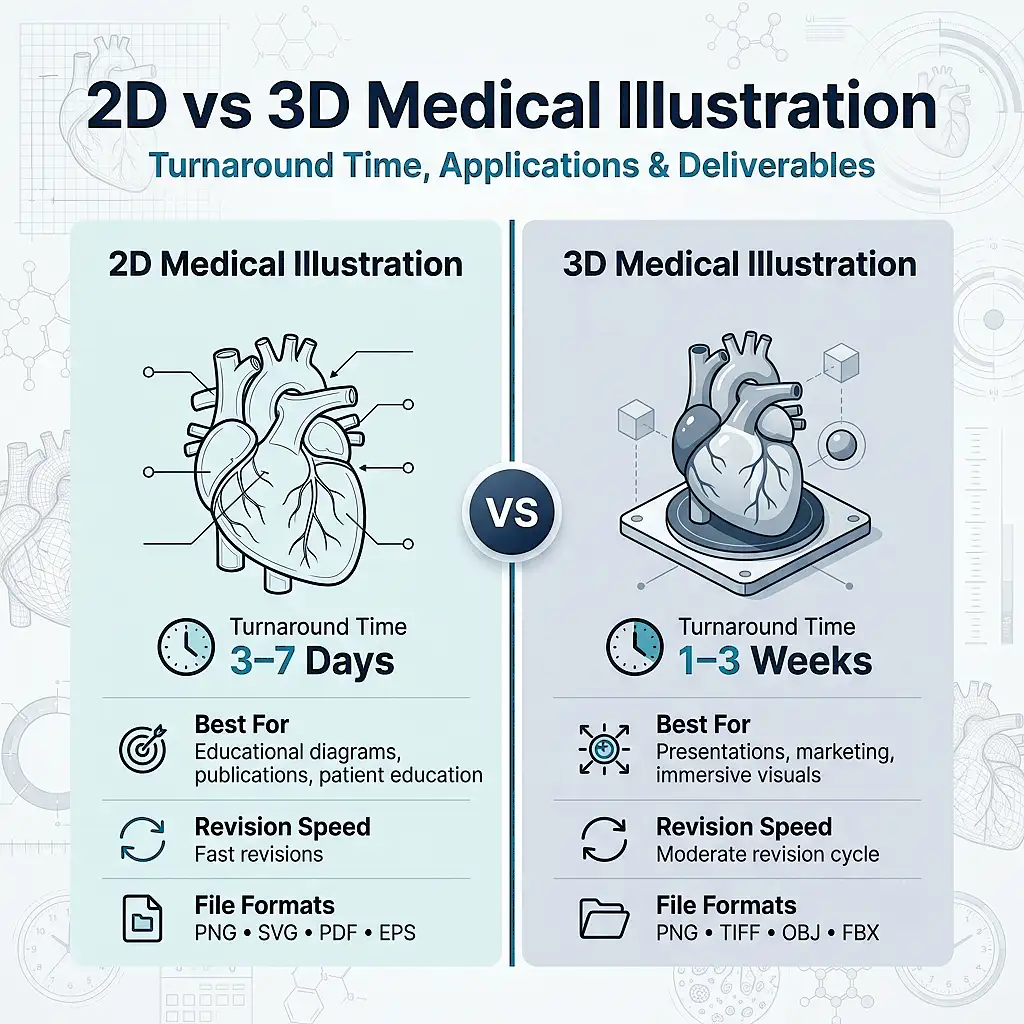
3D medical illustrations, on the other hand, generally require a longer production schedule, usually ranging from one to three weeks. Creating a three-dimensional model involves additional stages such as modeling, texturing, lighting, and rendering, which naturally increase production time. However, the extra effort provides greater depth and realism, making 3D visuals particularly valuable for surgical training, medical device demonstrations, pharmaceutical marketing, and other applications where immersive visuals are important. Since changes often require re-rendering parts of the scene, revisions typically take longer than they do with 2D artwork. Final files are commonly supplied in formats such as JPG, PNG, MP4, and interactive 3D formats. In short, if your priority is a faster turnaround and maximum revision flexibility, 2D medical illustration is usually the more efficient choice. If your project benefits from highly detailed and visually engaging imagery and can accommodate a longer schedule, 3D medical illustration offers capabilities that traditional 2D artwork cannot provide.
| Aspect | 2D Medical Illustration | 3D Medical Illustration |
|---|---|---|
| Typical Turnaround | 3-7 business days | 1-3 weeks |
| Best For | Journal figures, patient handouts, slide decks | Surgical training, marketing visuals, product demos |
| Revision Flexibility | Fast, minor edits same day | Slower, may require re-rendering |
| File Formats | JPG, PNG, EPS, AI | JPG, PNG, MP4, interactive 3D files |
Why Working With an Experienced Studio Shortens Turnaround Time
Studios that handle high volumes of clinical and scientific content develop internal libraries of anatomical references, established style guides, and streamlined review checklists. This means less time spent on research and more time spent on actual production. Additionally, experienced teams know how to flag potential accuracy issues early, before they become time-consuming revisions later in the process.
For clients comparing service providers, it also helps to understand related production options, such as the distinction outlined in medical illustration versus medical animation, since animation projects follow a markedly different and longer production schedule.
According to the National Center for Biotechnology Information, accurately rendered visual material plays a measurable role in improving comprehension of complex medical concepts among both clinicians and patients, underscoring why investing adequate production time in accuracy is rarely wasted.
Frequently Asked Questions
What is the average medical illustration turnaround time?
The average medical illustration turnaround time ranges from 3 to 10 business days for a single static illustration, depending on complexity, the number of revisions, and whether reference material is readily available.
Can medical illustration turnaround time be reduced for urgent projects?
Yes. Many studios offer rush or expedited services that can compress medical illustration turnaround time to 24-72 hours for select projects, often at an additional fee.
Does 3D medical illustration take longer than 2D illustration?
Generally, yes. 3D medical illustration involves modeling, texturing, lighting, and rendering, which can extend the timeline to 1-3 weeks compared to a few days for a comparable 2D piece.
What factors most affect medical illustration delivery time?
The biggest factors are the complexity of the subject matter, the number of revision rounds, the availability of reference material or source data, the illustration style requested, and whether the project requires scientific or regulatory accuracy review.
How can I speed up my medical illustration project?
Provide clear briefs, reference images, and source documents upfront, consolidate feedback into a single revision round, approve sketches promptly, and communicate deadlines clearly before the project begins.
Final Thoughts on Medical Illustration Turnaround Time
Medical illustration turnaround time is rarely a single fixed figure, but with the right preparation, it becomes highly predictable. Clear briefs, prompt feedback, and realistic expectations around complexity all play a direct role in keeping projects on schedule. Whether you need a single clinical diagram within a week or a full 3D animation over several weeks, understanding these timelines upfront helps you plan launches, submissions, and campaigns with confidence.
If you have an upcoming project and want a realistic, project-specific timeline,
get a free quote and turnaround estimate from our medical illustration team today.