
Patient health literacy illustration converts dense clinical language into visual formats the brain processes in milliseconds, not minutes. It reduces cognitive load by pairing text with anatomically accurate imagery, which is why illustrated materials consistently outperform text-only handouts in comprehension and recall studies. For hospitals, clinics, pharmaceutical brands, and medical publishers, this single shift in format often determines whether a patient actually follows a treatment plan or quietly abandons it out of confusion.

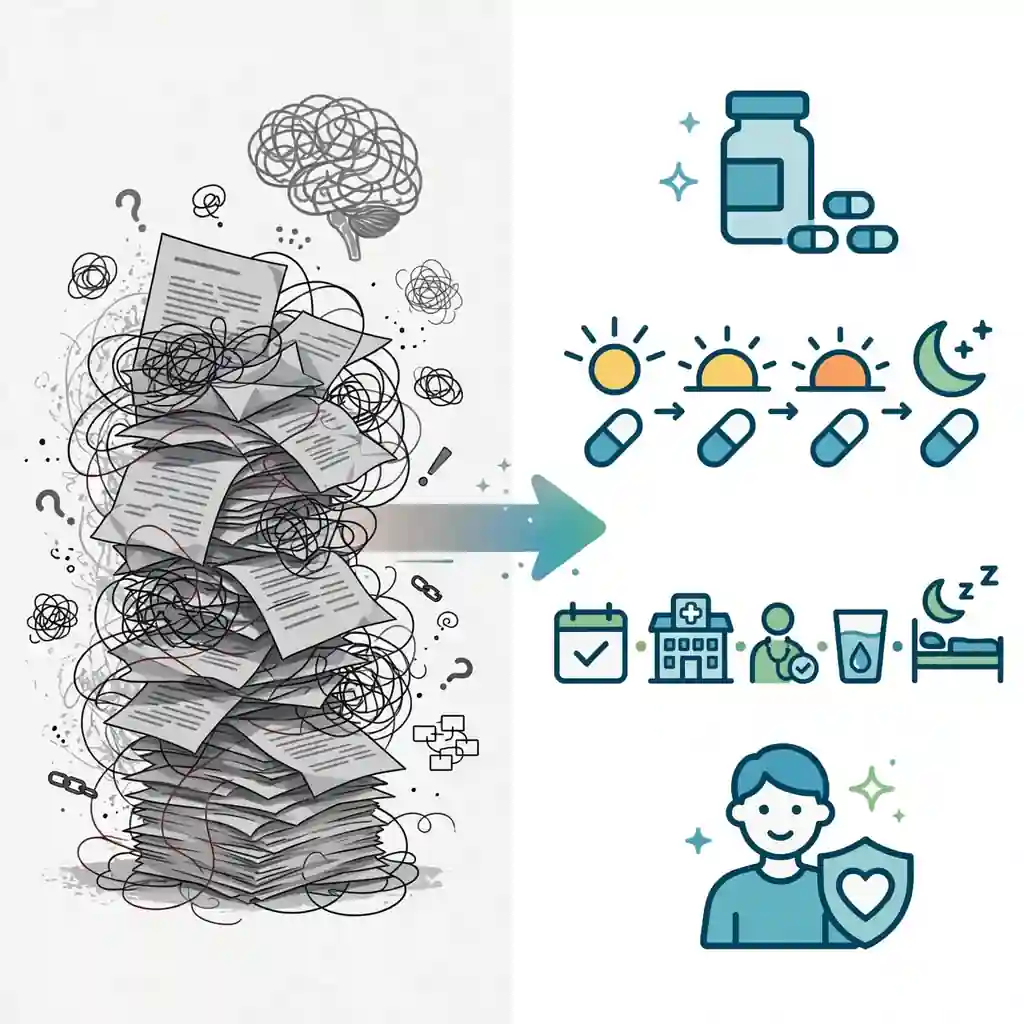
Health literacy gaps cost the U.S. healthcare system billions of dollars every year in avoidable readmissions, medication errors, and missed follow-ups. Yet the fix is rarely more paperwork; it is clearer visual storytelling. That is precisely the gap that professional medical illustration services are built to close, translating dense clinical narratives into diagrams patients can actually act on.
What Is Patient Health Literacy, Exactly?
Patient health literacy is the degree to which an individual can find, understand, and use basic health information to make sound decisions about their own care. It is not the same as general literacy. A patient can read fluently in English and still struggle to interpret a surgical consent form, a medication schedule, or an anatomical diagram of their own condition.
According to the Centers for Disease Control and Prevention, personal health literacy also includes the ability to communicate that understanding back to a provider. In other words, comprehension has to travel in both directions.
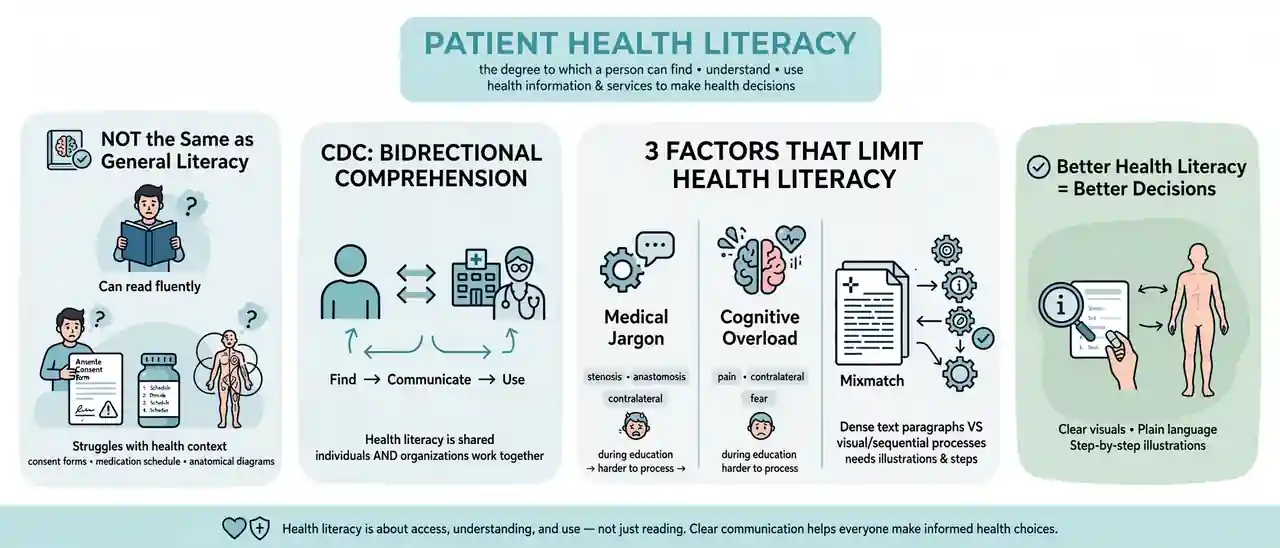
Three factors typically limit health literacy in a clinical setting:
- Medical jargon that has no everyday equivalent (stenosis, anastomosis, contralateral)
- Cognitive overload during moments of stress, pain, or fear, which is exactly when most patient education happens
- Format mismatch, where dense paragraphs are used to explain spatial, sequential, or mechanical processes that words alone cannot fully carry
This last point is where patient health literacy illustration earns its place in every serious patient communication strategy.
Why Medical Illustrations Improve Patient Understanding
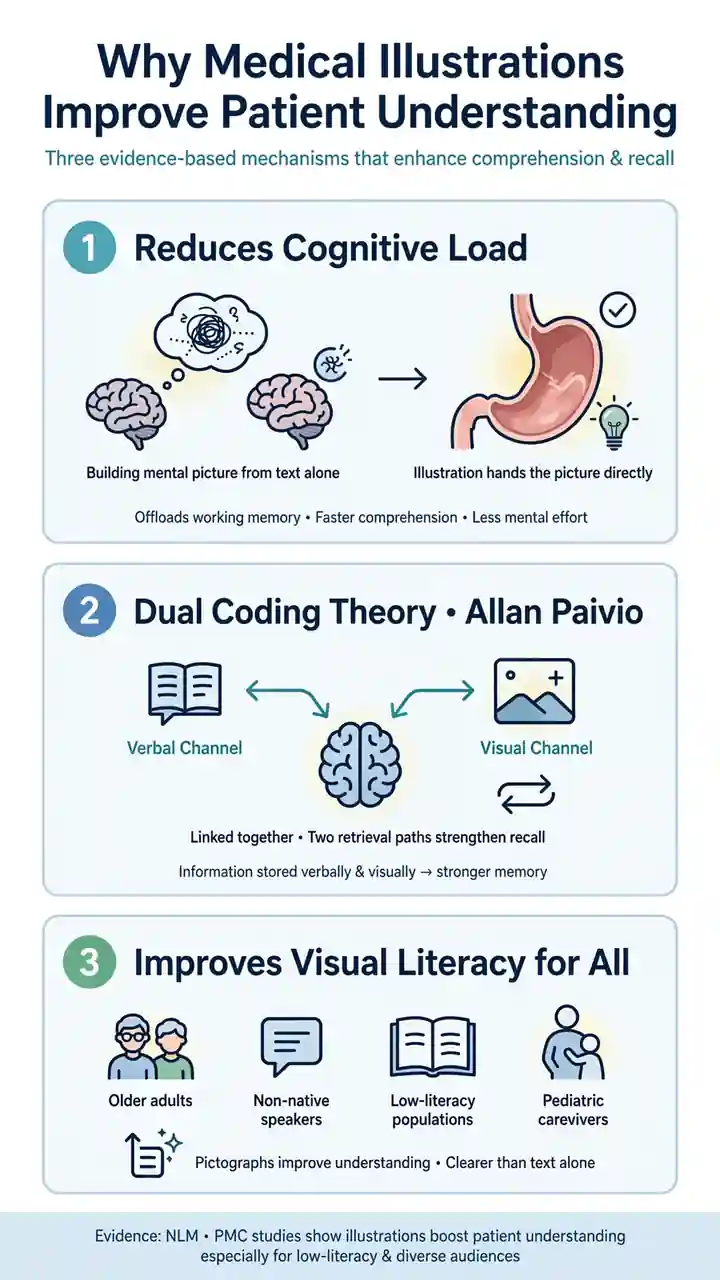
Illustrations do not simply decorate a page. They restructure how information is processed, stored, and later recalled. Three mechanisms explain why.
Illustrations Reduce Cognitive Load
Text-only instructions force the brain to build a mental picture from scratch, sentence by sentence. A well-constructed medical illustration hands that picture over directly. Consequently, the patient spends less mental effort decoding the message and more effort absorbing it.
Illustrations Trigger Dual Coding
Cognitive scientist Allan Paivio’s dual coding theory holds that the brain stores verbal and visual information through separate but linked channels. When a diagram is paired with plain-language captions, both channels activate together, and each reinforces the other. As a result, recall improves because the patient has two retrieval paths to the same fact instead of one.
Illustrations Support Visual Literacy in Low-Literacy Populations
Patients with limited reading proficiency, older adults, non-native speakers, and pediatric caregivers all lean more heavily on visual cues. A peer-reviewed pilot study published in the National Library of Medicine’s PMC archive found that supplementing free-text discharge instructions with pictographs produced a statistically significant improvement in patient recall compared with text alone. That single finding underpins most modern patient education design.
Types of Medical Illustrations That Strengthen Health Literacy
Not every illustration style serves the same purpose. Choosing the right format for the right clinical moment is central to any patient health literacy illustration strategy.
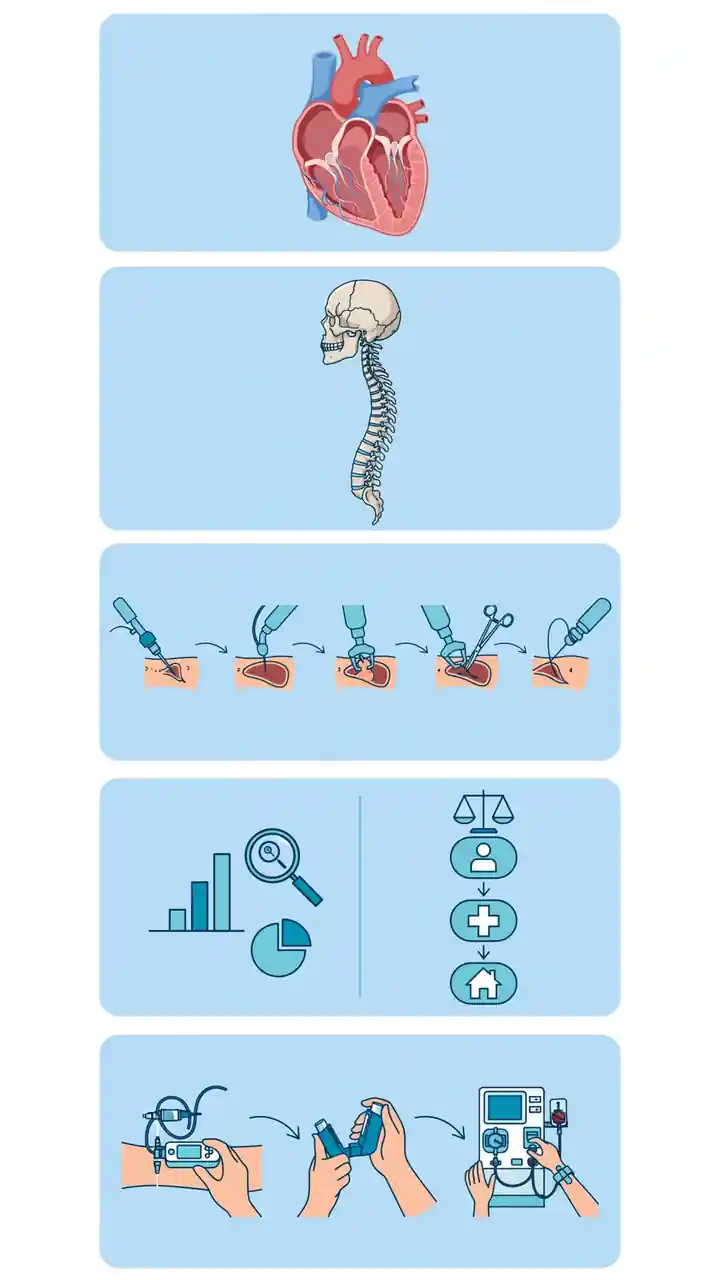
Anatomical and Cross-Sectional Illustrations
These show the structure of an organ, joint, or system in isolation. They are ideal for explaining “what is happening inside my body” without the noise of surrounding tissue.
3D Medical Illustrations
Rotatable, depth-accurate 3D renders help patients visualize spatial relationships that flat 2D diagrams sometimes flatten into confusion. Readers curious about the technical side of this format can explore our detailed breakdown of what 3D medical illustration actually involves and how it differs from traditional line art.
Procedural and Surgical Step Diagrams
Step-by-step visual sequences are especially effective for consent conversations, since patients need to understand not just the outcome but the process. Our walkthrough of laparoscopic and robotic procedure diagrams shows how sequencing alone can turn an intimidating surgery into a manageable five-step story.
Infographics and Comparison Visuals
These combine icons, short text, and simple charts to summarize an entire care pathway on a single page, ideal for discharge folders and waiting-room posters.
Medical Device and Product Illustrations
Patients managing insulin pumps, inhalers, or home dialysis equipment need illustrations that show exactly where their hands go and in what order, not abstract renderings of the device alone.
Where Illustrations Are Used to Build Patient Health Literacy
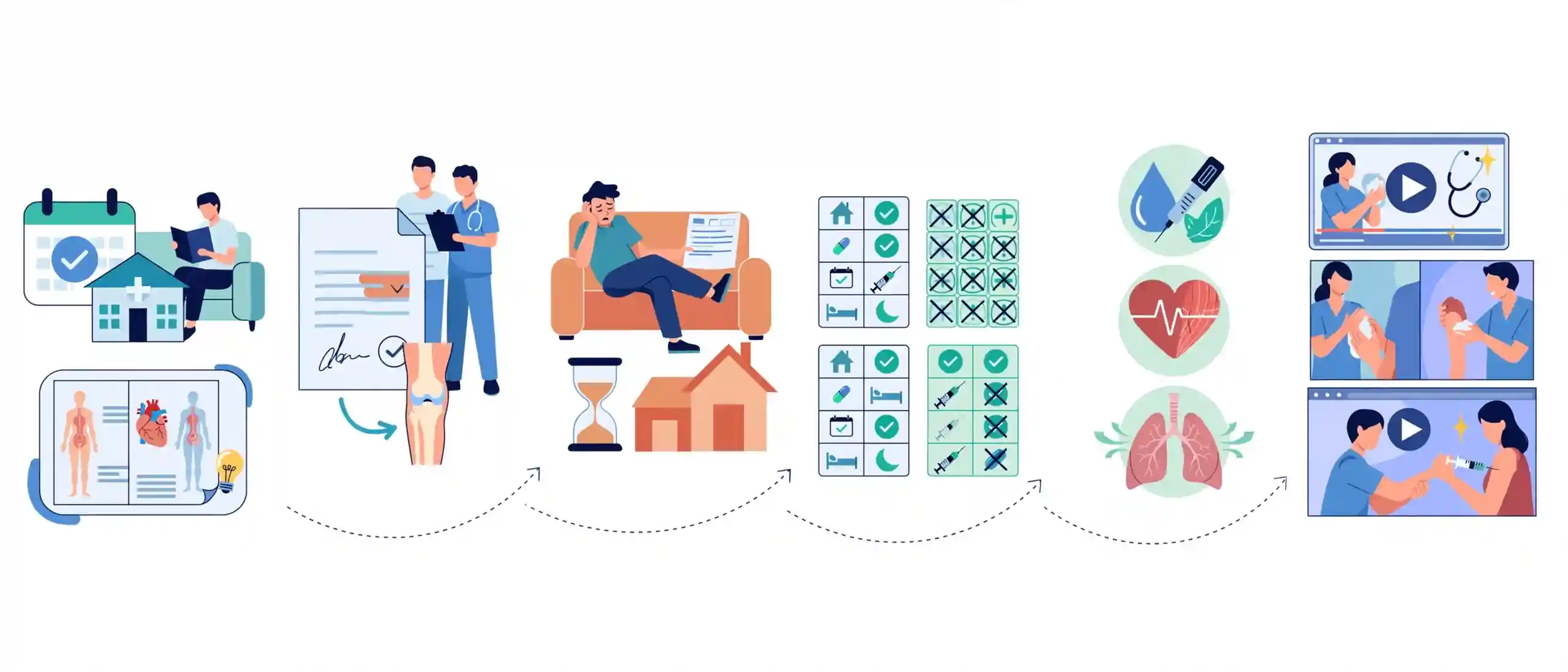
Patient health literacy illustration is not confined to a single touchpoint. It shows up across the entire care journey.
- Pre-visit education materials that set expectations before an appointment
- Informed consent documents that visually confirm what a procedure involves
- Discharge instructions that patients often read hours after leaving, under stress and fatigue
- Medication schedules, where icons reduce dosing errors far more reliably than dense text tables
- Chronic disease management guides for diabetes, cardiovascular conditions, and respiratory illness
- Training videos for staff and patients alike, where animated or static illustrations demonstrate technique, a use case we cover in depth in our guide to medical illustrations for training videos
For a broader foundation on this subject, our earlier piece on medical illustration for patient education remains one of the most referenced resources on our blog.
Illustrated Materials vs. Text-Only Materials: A Side-by-Side Comparison
| Factor | Text-Only Materials | Illustrated Materials |
|---|---|---|
| Comprehension speed | Slower; requires sequential reading | Faster; spatial relationships are grasped at a glance |
| Recall after 24-48 hours | Lower, especially for low-literacy patients | Significantly higher due to dual coding |
| Accessibility for non-native speakers | Limited without translation | High; visuals reduce language dependency |
| Emotional reassurance | Minimal | Higher; visuals demystify unfamiliar procedures |
| Production cost | Lower upfront | Moderate upfront, lower long-term due to reuse across formats |
| Regulatory and consent clarity | Prone to misinterpretation | Clearer depiction of risk and anatomy |
Medical Illustration vs. Medical Animation: Which Builds Health Literacy Faster?
Illustration and animation both support patient health literacy illustration goals, but they solve slightly different problems.
| Factor | Static Medical Illustration | Medical Animation |
|---|---|---|
| Best for | Quick reference, printed materials, consent forms | Explaining motion, sequence, or dynamic physiology |
| Production time | Shorter | Longer, given frame-by-frame development |
| Patient use case | Take-home handouts, posters, journal figures | In-clinic screens, pre-op waiting rooms, websites |
| Cost | Lower | Higher |
| Retention for one-time viewing | Strong | Very strong, but requires playback access |
If you are deciding between the two for a specific campaign, our comparison of the difference between medical illustration and medical animation breaks down the decision criteria in more detail.
Common Mistakes Healthcare Teams Make With Patient Education Visuals

Even well-funded patient education programs fall into predictable traps.
- Using stock anatomy art that does not match the patient’s actual condition, which erodes trust the moment a patient notices the mismatch
- Overloading a single illustration with every possible detail, instead of isolating the one concept the patient needs right now
- Skipping plain-language captions, so the visual still requires a medical dictionary to interpret
- Ignoring cultural and demographic context, such as body type, skin tone, or age representation
- Treating illustration as a one-time project rather than an evolving library tied to updated clinical guidelines
- Failing to test comprehension with real patients before rolling materials out system-wide
Expert Tips for Creating Health-Literacy-Friendly Medical Illustrations
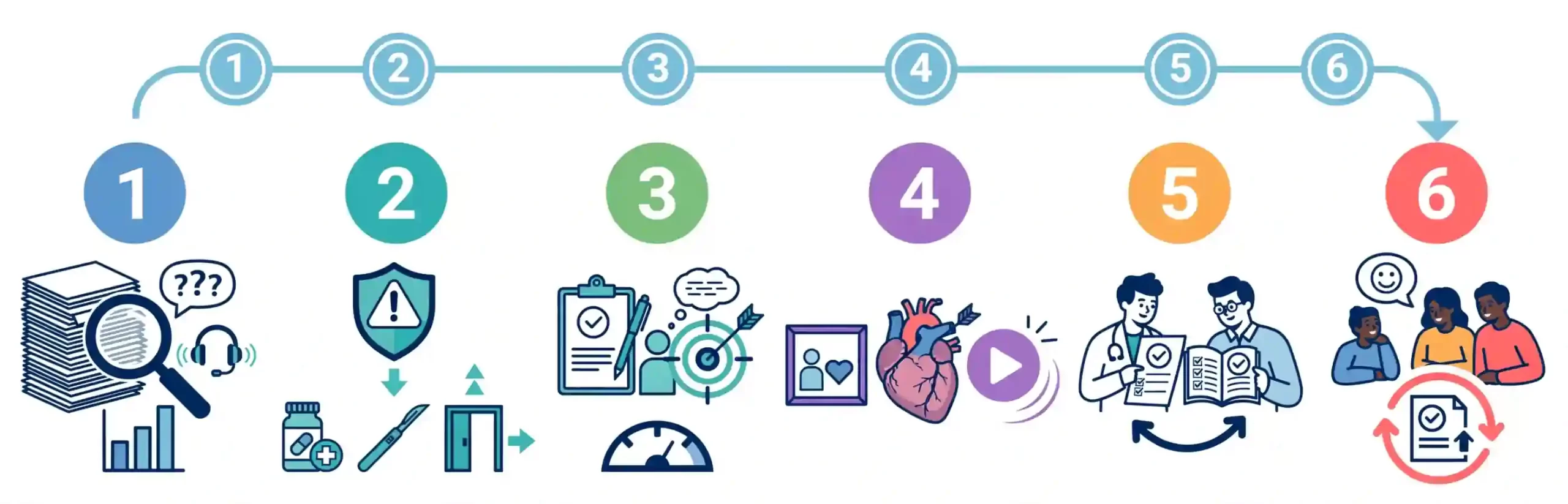
- Start with the patient’s question, not the clinical concept. “Why does my knee hurt when I climb stairs?” produces a very different illustration brief than “explain patellofemoral pain syndrome.”
- Limit each visual to one core idea. Multi-layered diagrams belong in journals, not in patient handouts.
- Pair every illustration with an eighth-grade reading level caption, since that is the literacy benchmark most U.S. health agencies recommend.
- Use consistent color coding across an entire patient journey so returning patients recognize familiar visual cues.
- Commission illustrations reviewed by both a medical professional and a health literacy specialist, since accuracy and clarity require different expertise.
- Design for print and screen simultaneously, because patients often photograph a screen instructions with their phone rather than requesting a printout.
- Revisit illustrations whenever clinical protocols change, particularly for surgical or device-based instructions.
Step-by-Step: How to Commission Patient Education Illustrations
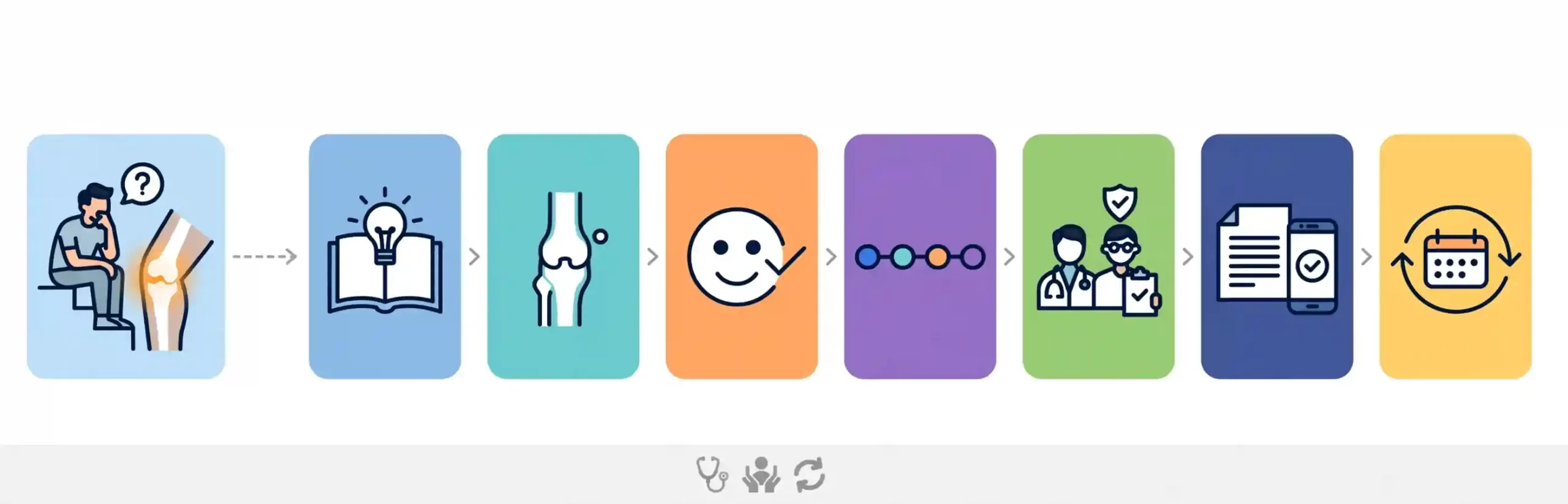
For healthcare marketing teams and clinical education departments building a program from scratch, the process generally follows six stages.
- Audit existing materials for text-heavy sections that consistently generate patient questions or call-center volume.
- Prioritize by clinical risk, starting with materials tied to medication safety, surgical consent, or discharge instructions.
- Write a clear creative brief naming the audience, reading level, and the single takeaway each illustration must deliver.
- Select the right format between static illustration, 3D rendering, or animation based on the comparison table above.
- Route drafts through clinical and health literacy review, not design review alone.
- Test with a small patient panel before full rollout, then iterate based on comprehension feedback.
Measuring the Impact of Patient Health Literacy Illustration
Healthcare organizations that invest in illustrated patient education typically track outcomes such as:
- Reduction in post-discharge phone calls asking for clarification
- Higher medication adherence rates among patients issued illustrated pill schedules
- Shorter average consent-conversation time in pre-operative settings
- Improved patient satisfaction scores tied to “I understood my care plan” survey items
Peer-reviewed research consistently supports these outcomes. The AHRQ Health Literacy Universal Precautions Toolkit recommends visual aids as a core, evidence-backed strategy for reducing miscommunication across every patient interaction, not only for patients formally flagged as low-literacy.
The Role of Professional Custom Medical Illustration Services
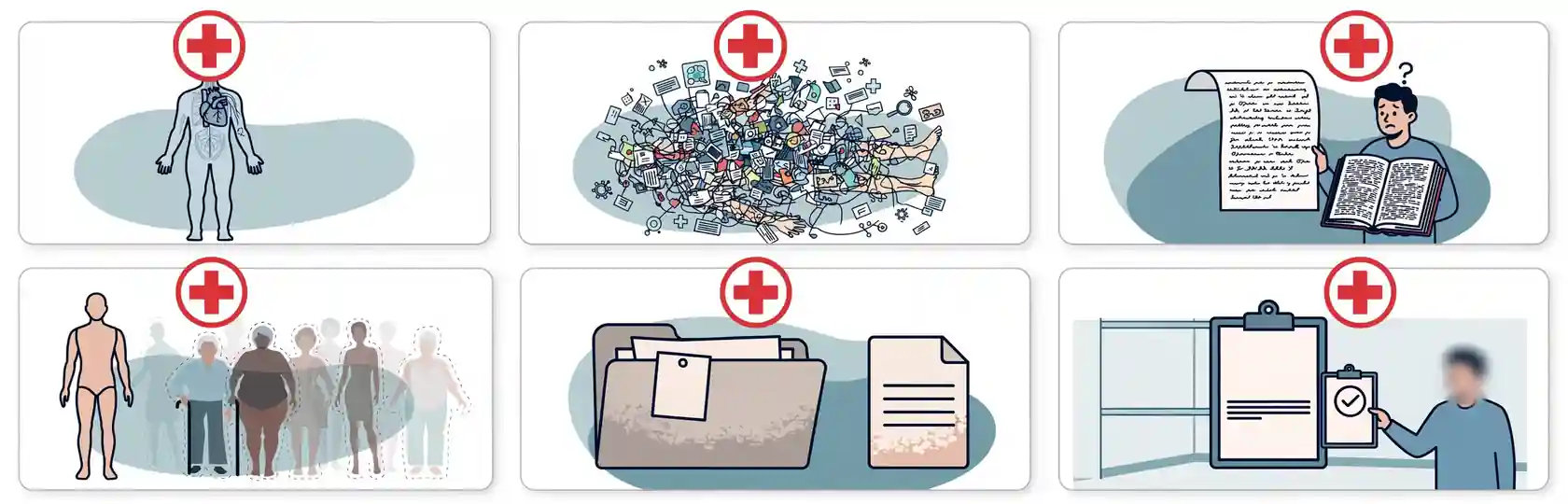
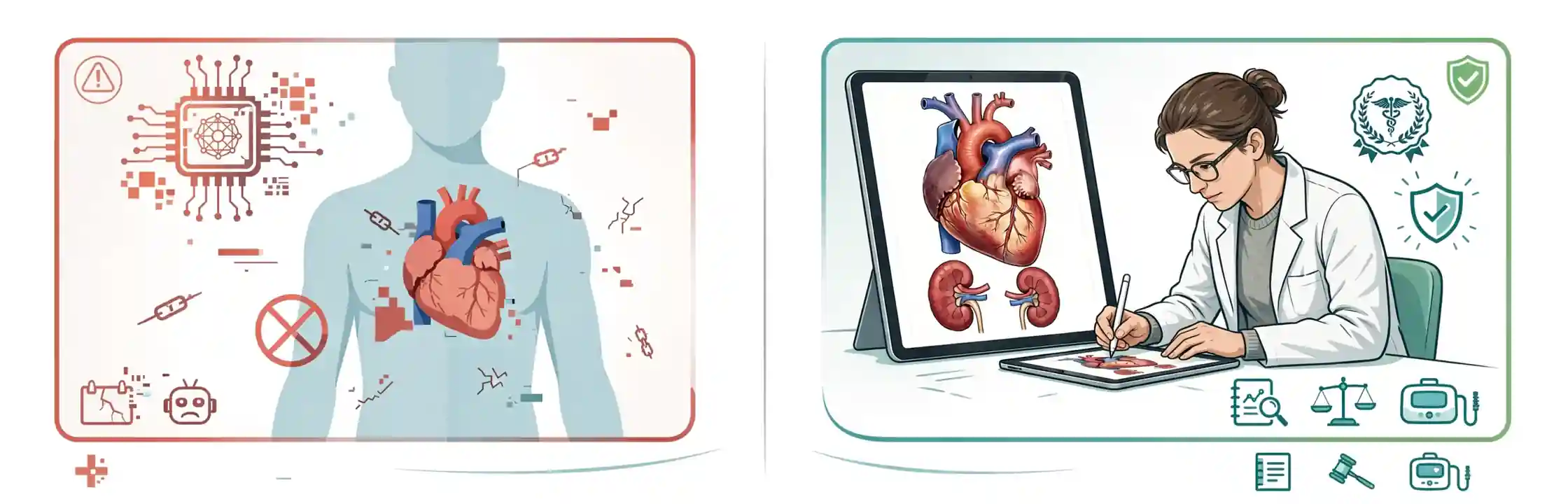
Generic clip art and AI-generated stock anatomy rarely survive clinical accuracy review. Custom illustration, built with input from board-certified medical illustrators, closes that gap. It ensures every structure, label, and proportion reflects the actual clinical reality rather than an approximation.
This is also where the broader case for medical illustration becomes clear. Our overview of why medical illustrations matter covers the full range of use cases beyond patient education, including research publication, legal demonstratives, and device marketing, each of which reinforces the same underlying principle: accurate visuals build trust faster than text alone.
For teams exploring this space for the first time, browsing our full blog library is a useful next step, since it houses deeper guides on formats, software, and industry standards referenced throughout this article.
Frequently Asked Questions
What is patient health literacy illustration?
Patient health literacy illustration is the practice of using accurate medical visuals, including anatomical diagrams, 3D renders, and procedural graphics, to help patients understand health information that would otherwise require advanced reading comprehension.
Why do illustrations improve health literacy more than text alone?
Illustrations reduce cognitive load and activate dual coding, meaning the brain stores the same information through both a visual and a verbal channel. This produces faster comprehension and stronger long-term recall, particularly for patients with limited reading proficiency.
Who benefits most from illustrated patient education materials?
Older adults, non-native speakers, pediatric caregivers, and patients managing chronic conditions all show measurable comprehension gains when illustrated materials replace text-only formats, though the benefit extends to nearly every patient population.
What types of medical illustrations are used for patient education?
Common formats include anatomical diagrams, 3D medical illustrations, procedural step sequences, infographics, and device-specific illustrations, each suited to a different stage of the patient journey.
How do hospitals measure the impact of illustrated patient materials?
Common metrics include reduced post-discharge clarification calls, improved medication adherence, shorter pre-operative consent conversations, and higher patient satisfaction scores on comprehension-related survey items.
Can AI-generated illustrations replace professional medical illustrators for patient materials?
Generic or AI-generated anatomy often fails clinical accuracy review, since subtle anatomical errors can mislead patients or create liability concerns. Professional medical illustration services combine artistic skill with clinical validation, which remains essential for consent forms, discharge materials, and any visual tied to patient safety.
Conclusion
Patient health literacy illustration is no longer a nice-to-have addition to patient education. It is a measurable lever for reducing miscommunication, improving adherence, and building the kind of trust that text alone rarely achieves. Whether the goal is clearer consent forms, better discharge instructions, or a stronger patient education library across an entire hospital system, accurate and thoughtfully designed illustrations consistently move the needle.

If your team is ready to close these gaps, partner with our medical illustration studio to build a patient education visual library that clinicians trust and patients actually understand.