
Scientific illustration is a specialized visual communication discipline that combines rigorous scientific accuracy with refined artistic technique to produce precise, factual depictions of biological organisms, anatomical structures, natural phenomena, medical devices, and technical systems.
The scientific illustration definition encompasses a methodical process of research, visual synthesis, and accurate rendering, executed by practitioners trained at the intersection of natural sciences and visual art.
These illustrations serve as indispensable tools across medicine, research, education, and publishing – bridging the gap between complex empirical data and clear, accessible understanding.
Whether you work in clinical research, pharmaceutical development, science education, or medical publishing, partnering with a team that offers professional medical and scientific illustration services can fundamentally transform how your audience receives, retains, and acts on critical visual information.
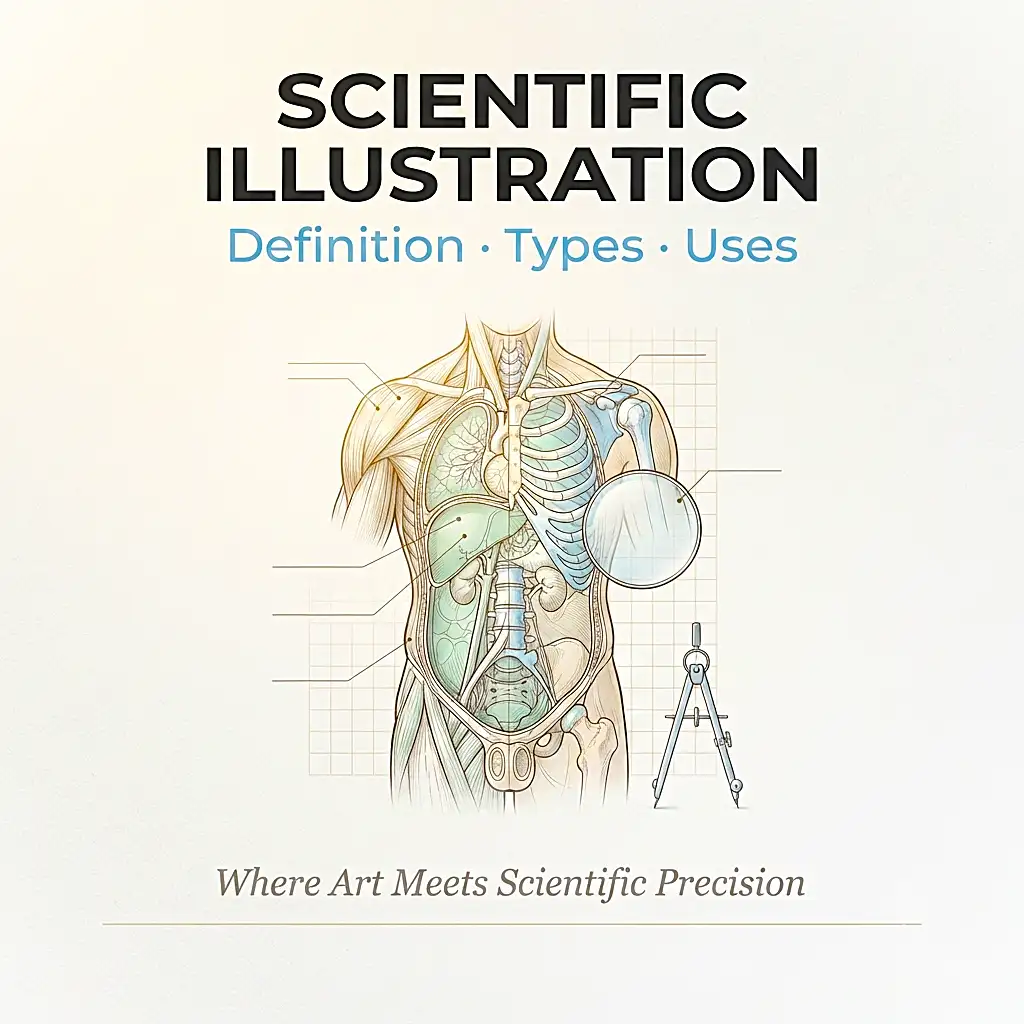
The Scientific Illustration Definition: What It Really Means
At its core, the scientific illustration definition refers to the creation of technically accurate, purposefully structured visual representations of subjects in the natural or applied sciences. This definition is considerably broader than most people initially assume.
It covers outputs ranging from hand-rendered botanical drawings to digitally produced anatomical cross-sections, from molecular pathway diagrams to multi-step surgical procedure sequences. What unifies these diverse formats is a shared, non-negotiable commitment to verifiable accuracy over aesthetic expression.
According to the Association of Medical Illustrators (AMI), scientific and medical illustrators are graduate-level professionals trained to translate complex scientific concepts into clear, accurate, and compelling visuals. This level of specialized expertise is precisely what separates scientific illustration from general commercial art or decorative graphic design.
Four core attributes define every legitimate scientific illustration:
- Accuracy: Every depicted detail must reflect factual, verifiable scientific information.
- Purpose: Each visual element serves a communicative function, not merely an aesthetic one.
- Expertise: Creators possess substantive domain knowledge of the subject they depict.
- Context: Illustrations are calibrated for a specific scientific, medical, or educational audience.
The result is a visual that can stand alongside peer-reviewed research, inform surgical training, guide a patient through a complex diagnosis, or support a regulatory submission – all without misrepresenting the underlying science in any way.
A Brief History: From Renaissance Anatomy to Digital Studios
Scientific illustration carries a long and distinguished history. During the Renaissance, polymaths like Leonardo da Vinci and anatom During the Renaissance, polymaths like Leonardo da Vinci and anatomists like Andreas Vesalius pioneered the integration of anatomical study with visual art, producing detailed cadaveric drawings that remained authoritative references for centuries.
In the 17th and 18th centuries, natural history expeditions depended heavily on scientific illustrators to document newly discovered plant and animal species. These hand-rendered field drawings represented the only visual records of global biodiversity in an era before photography or digital capture.
Photography eventually changed how scientific visuals were produced. However, it did not replace illustration. In many scientific contexts, illustration remains demonstrably superior because it can:
- Emphasize specific anatomical structures while eliminating irrelevant visual noise.
- Depict internal anatomy that is physically impossible to photograph directly.
- Represent sequential processes – such as cell division, surgical steps, or drug mechanisms of action.
- Show composite or idealized forms that no single physical specimen represents accurately.
Today, digital tools have substantially expanded what scientific illustrators can create and deliver. Nevertheless, the foundational principles of accuracy, clarity, and scientific integrity remain as non-negotiable as ever.
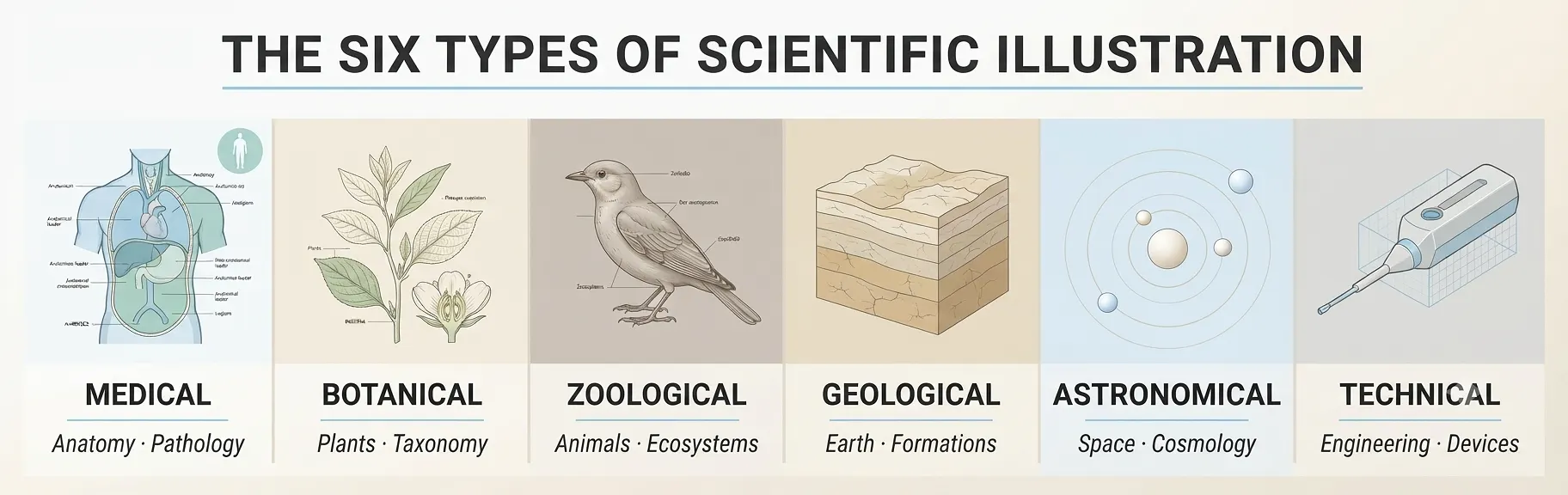
The Main Types of Scientific Illustration
Understanding the distinct branches of scientific illustration helps researchers, publishers, and healthcare organizations identify the right specialization for each project. Each branch requires a different knowledge base, a different visual vocabulary, and a different level of domain-specific scientific training.
Medical and Anatomical Illustration
Medical illustration is the most widely recognized form of scientific illustration. It covers accurate depictions of human anatomy, clinical pathology, surgical procedures, and medical devices. Professionals in this discipline work directly alongside surgeons, pharmaceutical researchers, and medical educators to produce visuals for textbooks, patient education materials, journal submissions, and procedural training content.
For a thorough grounding in this specialization, this in-depth overview of what medical illustration involves covers the skills, tools, workflows, and professional contexts that define the field today.
Botanical Illustration
Botanical illustration depicts plant subjects with the morphological precision required for scientific identification and documentation. Illustrators accurately render root systems, leaf venation patterns, pollen microstructure, and reproductive organs in ways that even high-resolution photography often cannot fully capture. This discipline directly supports taxonomy, conservation biology, and pharmaceutical research into plant-derived active compounds.
Natural History and Zoological Illustration
Natural history illustration documents animal species, insect morphology, avian plumage, and ecological relationships with scientific fidelity. Museums, field guide publishers, conservation organizations, and research institutions regularly commission these illustrations to communicate species diversity and document biodiversity patterns.
The Guild of Natural Science Illustrators (GNSI) represents practitioners in this specialization and maintains professional standards for accuracy and technique across all natural science visualization disciplines.
Geological and Earth Science Illustration
Geological illustration visualizes subsurface formations, tectonic plate processes, mineral crystal structures, and stratigraphic profiles. These images support geoscience research, environmental impact assessments, resource exploration reports, and university-level earth science curricula.
Astronomical Illustration
Astronomical illustration depicts space objects, cosmological events, and theoretical astrophysical models that cannot be directly photographed at adequate resolution with current technology. Space agencies, science museums, and educational publishers rely heavily on these illustrations to communicate cosmological concepts to both specialist and general audiences alike.
Technical and Engineering Illustration
Technical illustration represents manufactured systems: medical instruments, mechanical assemblies, circuit diagrams, and industrial components. Within the healthcare sector specifically, this specialization encompasses medical device illustration – showing precisely how instruments function inside the body or during a clinical procedure.
Types of Scientific Illustration: Quick Reference Table
| Type | Primary Focus | Common Applications | Key Industries |
|---|---|---|---|
| Medical / Anatomical | Human body, procedures, pathology | Textbooks, patient education, surgery training, pharma aids | Healthcare, publishing, pharma |
| Botanical | Plant morphology and taxonomy | Field guides, conservation reports, drug research | Biology, medicine, agriculture |
| Natural History / Zoological | Animals, ecosystems, biodiversity | Museums, field guides, science media | Conservation, education |
| Geological | Earth structures, mineral formations | Research papers, environmental studies | Geoscience, engineering |
| Astronomical | Space, celestial events, cosmology | Science museums, space agencies, education | Aerospace, education |
| Technical / Engineering | Devices, machinery, systems | Product manuals, medical devices, patent filings | Engineering, medical devices |
Scientific Illustration vs. General Artistic Illustration: Key Differences
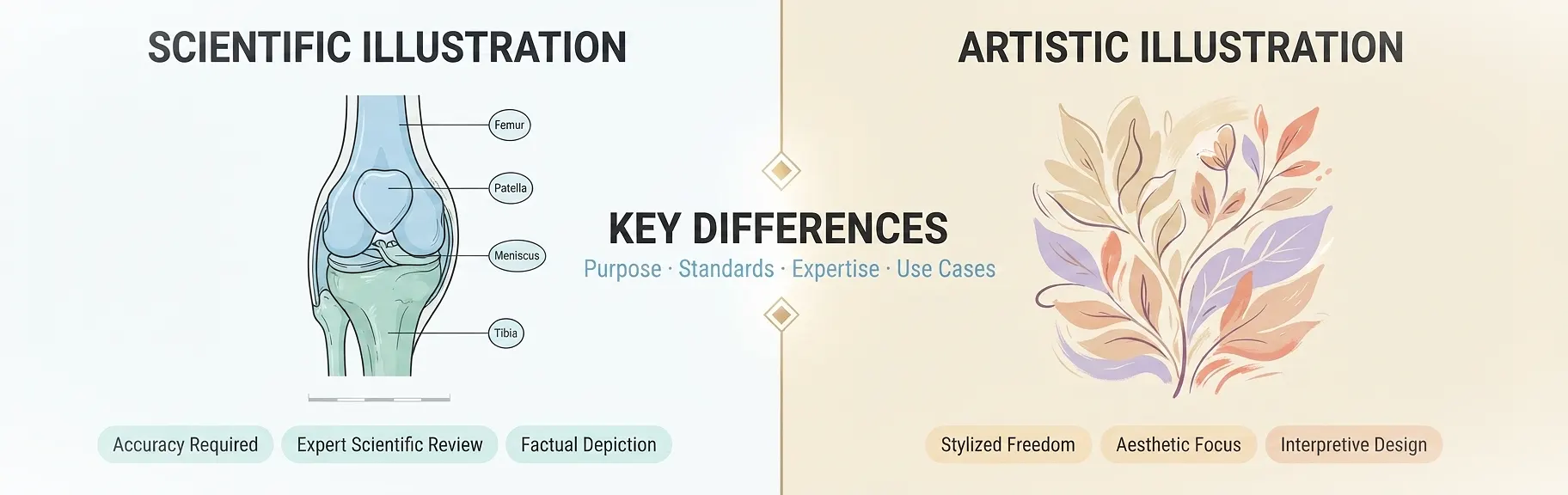
Many organizations conflate scientific illustration with general commercial or fine art illustration. These disciplines differ significantly in purpose, process, required expertise, and quality standards. Understanding this distinction protects both scientific accuracy and institutional credibility.
| Attribute | Scientific Illustration | General / Artistic Illustration |
|---|---|---|
| Primary Goal | Accurate communication of scientific fact | Visual expression, storytelling, aesthetics |
| Accuracy Standard | Factual, verifiable, research-backed | Subjective, stylized, interpretive |
| Creator Background | Science + art training (often graduate level) | Art or design training |
| Review Process | Subject matter expert review required | Client approval typically sufficient |
| Use Cases | Research, medical education, journal publications | Advertising, entertainment, branding |
| Tolerance for Artistic License | Minimal: accuracy is mandatory | High: visual style is actively encouraged |
| Standard Output Formats | Technical line art, anatomical diagrams, cross-sections | Concept art, character design, visual narratives |
This distinction matters critically for anyone commissioning work for scientific, medical, or regulatory purposes. Engaging a general illustrator for a scientific project frequently produces visually appealing but scientifically inaccurate results – outcomes that can undermine institutional credibility and, in clinical or educational contexts, create genuine risks for end users.
Key Uses of Scientific Illustration Across Industries
The practical applications of scientific illustration extend across virtually every knowledge-intensive sector. Understanding these use cases helps organizations identify precisely where this discipline adds the most measurable value.
In Healthcare and Medicine:
- Surgical procedure documentation for resident and specialist training programs
- Patient education materials that explain diagnoses, treatment options, and post-operative care pathways
- Medical device and product illustration for regulatory submissions and operator manuals
- Pharmaceutical visual aids prepared for clinical trial investigator meetings and prescriber education
In Scientific Research and Publishing:
- Journal article figures, diagrams, and plate illustrations
- Research poster and conference presentation graphics
- Grant proposal visual summaries prepared for non-specialist review panels
- Supplementary visual data packages for open-access publications
Well-crafted visual assets designed specifically for research publications can meaningfully improve manuscript clarity, support successful peer review, and increase citation impact in competitive journals.
In Education:
- University and secondary school textbook illustrations
- Online learning platform and e-learning module content
- Museum exhibit panels and interpretive science graphics
- Science communication campaigns targeting general public audiences
In Industry and Technology:
- Medical device and product operator manuals
- Engineering specification and assembly drawings
- Patent application technical illustrations
- Explainer videos and interactive procedural training simulations
Recognizing why visual accuracy is fundamental to effective healthcare content helps decision-makers make informed, strategic choices about investing in professional illustration rather than repurposing generic stock imagery that rarely meets scientific or clinical standards.
Scientific Illustration in Research Publishing: Standards You Need to Know
When scientific illustrations appear in peer-reviewed journals, they must satisfy strict editorial and ethical requirements. Publishers typically require that all submitted illustrations:
- Accurately represent data, anatomy, or subject matter without exaggeration, selective emphasis, or distortion.
- Include clear labels, scale bars, orientation markers, and complete legend information.
- Meet specified file format and resolution standards: commonly 300 DPI minimum for halftone images and 600-1200 DPI for line art.
- Conform to journal-specific color profile requirements: RGB for digital-only publications; CMYK for print editions.
- Avoid any digital manipulation that misrepresents the underlying data, specimen, or clinical finding.
Researchers preparing manuscripts benefit significantly from reviewing the submission standards for figures in scientific and medical journals before entering the production phase, rather than attempting to retroactively fix non-compliant artwork after submission.
The Role of Scientific Illustration in the Digital Age
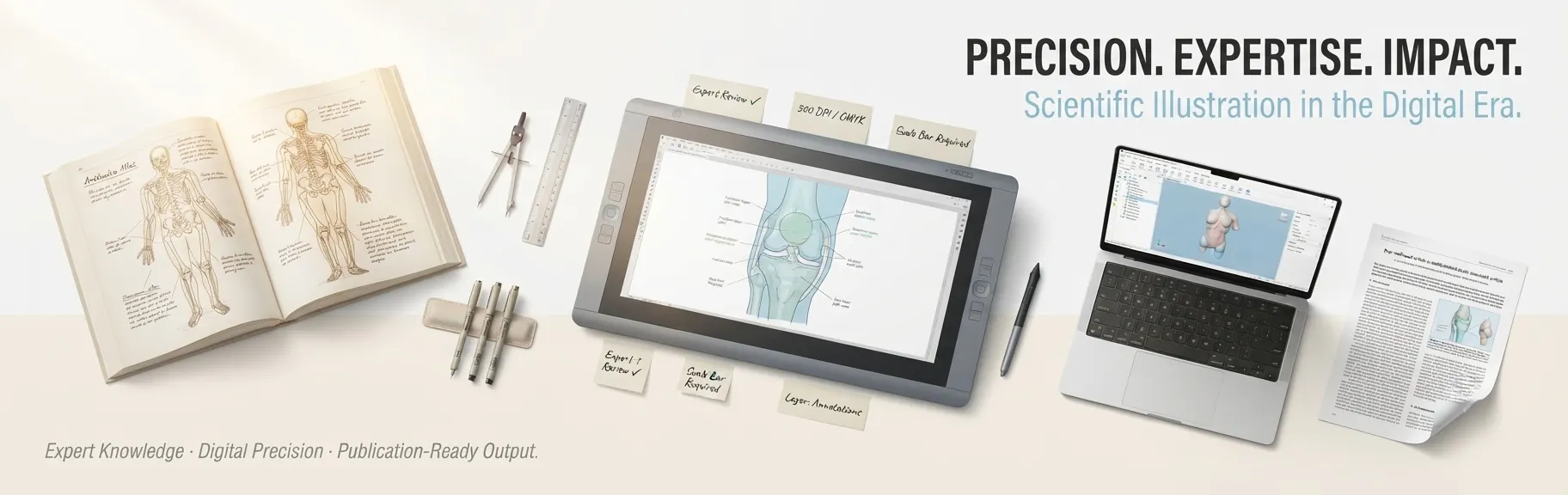
Digital technology has not diminished the relevance of scientific illustration; it has substantially expanded its scope, precision, and delivery formats. Modern scientific illustrators combine deep domain expertise with advanced software to produce outputs ranging from static journal figures to interactive 3D anatomical models and procedural medical animations.
Key developments driving the evolution of digital scientific illustration include:
- 3D rendering and volumetric modeling: Enables visualization of internal structures, molecular interactions, and procedural simulations with spatial clarity that 2D diagrams simply cannot match.
- Interactive digital content: Allows clinicians, students, and patients to explore anatomical structures in real-time browser-based environments with selectable layers and annotation.
- Animation and motion graphics: Communicates dynamic biological or clinical processes – drug mechanisms of action, immune cascade responses, or multi-step surgical sequences – that no static image can adequately convey.
- AI-assisted production tools: Support illustrators in managing repetitive workflow tasks and preliminary concept generation. The creative judgment, accuracy validation, and domain-specific knowledge, however, remain irreducibly human responsibilities.
Despite these advances, the fundamental scientific illustration definition remains unchanged: accuracy, communicative purpose, and scientific integrity are non-negotiable, regardless of which tools are used to produce the output.
How to Commission High-Quality Scientific Illustration: A Step-by-Step Guide
Commissioning scientific illustration effectively requires upfront preparation, clear and complete communication, and a realistic understanding of the production workflow. Following a structured process protects both scientific accuracy and project timelines from the start.
Step 1: Define Your Objective Clearly
Determine at the outset whether the illustration will appear in a journal submission, patient information brochure, device operator manual, training video, or regulatory filing. Each context carries different accuracy requirements, resolution specifications, and stylistic conventions that should be established before any visual work begins.
Step 2: Gather and Organize Your Reference Materials
Provide the illustrator with the most current scientific literature, specimen photographs, anatomical atlases, clinical imaging data, or existing diagrams that inform your subject matter. The quality and completeness of your reference materials directly determines the accuracy of the final illustration.
Step 3: Write a Thorough, Specific Brief
Include your intended audience, the required level of technical detail, any journal or client style guidelines, preferred color-coding conventions, labeling requirements, and output format specifications. Ambiguous briefs consistently produce ambiguous results.
Step 4: Review Concept Sketches Before Final Rendering
Most professional scientific illustrators deliver preliminary pencil or digital sketches for client approval before committing to the final rendering stage. Investing proper review time at this point prevents expensive corrections later.
Step 5: Conduct a Formal Expert Scientific Review
Have a qualified subject matter expert – a physician, molecular biologist, or research scientist – review the illustration for scientific accuracy before finalization. This step is non-negotiable for any work destined for publication, clinical training, or regulatory submission.
Step 6: Specify File Formats and Licensing Terms in Writing
Confirm which file formats you require (EPS, TIFF, PNG, SVG, or layered PSD/AI files), the intended usage territories, and whether you need exclusive licensing or open-use rights. Agree on these terms contractually before any production work begins.
Step 7: Archive Source Files and Documentation Securely
Store all source files, usage licenses, revision histories, and reference materials in a secure, organized archive. Illustrations frequently need revision or adaptation for different publications, formats, or audience groups over time.
Common Mistakes to Avoid When Commissioning Scientific Illustration
Even experienced research teams and well-resourced publishers make avoidable errors when commissioning scientific visuals. Recognizing these pitfalls in advance protects your project, your institutional credibility, and your budget.
Mistake 1: Prioritizing Visual Style Over Scientific Accuracy
Selecting an illustrator on the basis of portfolio aesthetics rather than scientific accuracy credentials is the single most common and costly error. In medical and scientific contexts, an inaccurate illustration can directly mislead clinicians, educators, or patients – with consequences that extend well beyond a failed submission.
Mistake 2: Skipping the Subject Matter Expert Review
Even highly experienced illustrators benefit from expert review. No illustrator possesses encyclopedic, up-to-date knowledge of every scientific domain. Building a formal review step into your production workflow is essential, not optional.
Mistake 3: Providing Insufficient Reference Material
Vague briefs consistently produce vague illustrations. The more precise and complete your source materials are, the more accurate, relevant, and reusable the final visual output will be.
Mistake 4: Ignoring Resolution and Color Profile Requirements
Submitting low-resolution artwork to journals, or producing illustrations in the wrong color space, generates expensive and time-consuming rework. Address all technical specifications at the briefing stage – not after delivery.
Mistake 5: Underestimating Production Timelines
Complex anatomical cross-sections, multi-panel surgical sequences, or 3D medical device renders require significantly more production time than general graphic design work. Build realistic, expert-informed timelines into your project plan from the outset.
Mistake 6: Failing to Clarify Intellectual Property and Licensing Rights
Vague or absent IP agreements create legal complications when illustrations are reused across multiple publications, international territories, or media formats. Resolve all licensing terms contractually before production starts.
Expert Tips for More Effective Scientific Illustration
Experienced scientific illustrators and researchers who regularly commission professional visuals consistently offer the following guidance based on real-world project experience:
- Design for your end user first. An illustration aimed at a first-year medical student requires a different level of abstraction and labeling density than one destined for a specialist surgical journal.
- Layer information across multiple panels. Complex biological or procedural processes communicate more effectively through sequential step diagrams or annotated panels than through a single dense, information-heavy image.
- Make color encode meaning, not decoration. Color should distinguish tissue types, process stages, temperature gradients, or structural differences – not simply make the image look visually appealing.
- Commission original work rather than adapting stock imagery. Stock scientific images rarely match your exact specimen, anatomical variant, or procedural context; attempting to adapt them typically introduces inaccuracies that compromise credibility.
- Plan for revision cycles from the outset. The most effective scientific illustrations emerge from iterative, expert-guided feedback loops between illustrator, researcher, and subject matter reviewer.
- Build for longevity and multi-format reuse. Illustrations that will serve multiple publications, training programs, or media formats should be created in scalable vector formats with future adaptation specifically in mind.
Exploring the proven advantages of investing in expert-level scientific visualization provides further context for understanding why high-quality illustration consistently produces measurable returns across research, education, and commercial healthcare applications.
Frequently Asked Questions About Scientific Illustration
Q: What is the scientific illustration definition in straightforward terms?
A: Scientific illustration is the practice of creating visually accurate, purposeful representations of scientific subjects – including organisms, anatomical structures, natural phenomena, and technical systems – to communicate scientific information clearly, precisely, and without ambiguity. Every element in a scientific illustration must reflect factual, verifiable information grounded in current scientific knowledge.
Q: How does scientific illustration differ from medical illustration?
A: Medical illustration is a specialized branch within the broader scientific illustration definition that focuses specifically on human anatomy, clinical procedures, medical devices, and healthcare communication. Scientific illustration is the parent discipline, encompassing botanical, zoological, geological, astronomical, and technical illustration as well as all medical visualization work.
Q: What qualifications do professional scientific illustrators typically hold?
A: Most professional scientific illustrators hold graduate-level degrees that formally integrate science and art training. Organizations such as the Association of Medical Illustrators (AMI) maintain certification programs and professional development standards that define competency benchmarks across the field.
Q: Can digital software replace the need for trained scientific illustrators?
A: Digital tools have transformed and significantly expanded what scientific illustrators can produce and deliver. However, they have not replaced the underlying discipline. The scientific accuracy, domain knowledge, expert judgment, and communicative design skills required to produce valid illustrations remain human responsibilities that no current software can independently fulfill.
Q: What file formats do scientific journals typically require for illustration submissions?
A: Most peer-reviewed journals request illustrations in TIFF or EPS format, at a minimum resolution of 300 DPI for halftone images and 600-1200 DPI for line art. Specific technical requirements vary by publication; always consult the journal’s author guidelines before beginning production.
Q: How long does it typically take to produce a scientific illustration?
A: Production time depends on subject complexity, the required level of anatomical or technical detail, and the number of expert review and revision cycles involved. A straightforward labeled diagram may require a few working days; a complex multi-panel anatomical cross-section or 3D medical device render may require several weeks of iterative development.
Q: Which industries rely most heavily on scientific illustration?
A: Healthcare, pharmaceutical development, academic publishing, science education, medical device manufacturing, natural history museums, conservation biology, and aerospace are consistently among the sectors that depend most heavily on high-quality scientific illustration.
Why the Scientific Illustration Definition Still Matters
The scientific illustration definition is not a historical artifact. It describes a living, evolving, and critically important professional discipline that shapes how scientific knowledge reaches clinicians, researchers, students, patients, and the broader public.
In a communication landscape saturated with stock imagery, AI-generated graphics, and low-resolution diagrams, the core standards that define scientific illustration – accuracy, communicative purpose, scientific integrity, and expert execution – are more strategically valuable today, not less.
Every research paper figure, anatomical training diagram, medical device rendering, and patient education visual represents a clear opportunity: to communicate with authority and credibility, or to undermine it. Understanding what scientific illustration is, how its types differ from one another, and where it applies most powerfully equips organizations to commission and deploy it strategically – and to realize returns on that investment across every format and audience it serves.
From grant proposals and regulatory filings to surgical training programs and public science communication campaigns, the evidence is consistent: accurate, expert-level visual science content produces measurable outcomes that generic alternatives simply cannot replicate.
If your organization needs publication-ready figures, anatomical diagrams, medical device visuals, or custom research illustrations produced to the highest accuracy and compliance standards, commission expert scientific and medical illustration work that delivers results – scientifically precise, audience-calibrated visuals built for real-world impact.