
Healthcare illustration is a specialized discipline of visual communication in which scientifically trained artists create anatomically accurate, clinically verified graphic content – spanning 2D diagrams, 3D rendered models, surgical step-by-step visuals, and infographic-format patient education materials – to support diagnosis, training, treatment communication, and biomedical research across the entire healthcare continuum. It bridges the gap between complex medical science and its audiences: clinicians, patients, researchers, legal professionals, and the general public. Unlike generic medical stock imagery, professionally produced healthcare illustration is purpose-built to convey precision, process, and clinical context that photography and AI-generated visuals simply cannot replicate.
Every year, hospitals, pharmaceutical companies, medical device manufacturers, and publishers commission thousands of healthcare illustrations to explain what the naked eye – or even advanced imaging – cannot show clearly. Whether you are a surgeon communicating a novel procedure to peers, a pharma brand explaining a drug’s mechanism of action, or a patient trying to understand an upcoming operation, healthcare illustration is the tool that transforms complexity into clarity.
If you need expert-level medical illustration and scientific visualization services for your next project – from anatomical diagrams and surgical atlases to medical device schematics and patient-facing health materials – working with a dedicated professional studio ensures your visuals meet the highest clinical and regulatory standards.
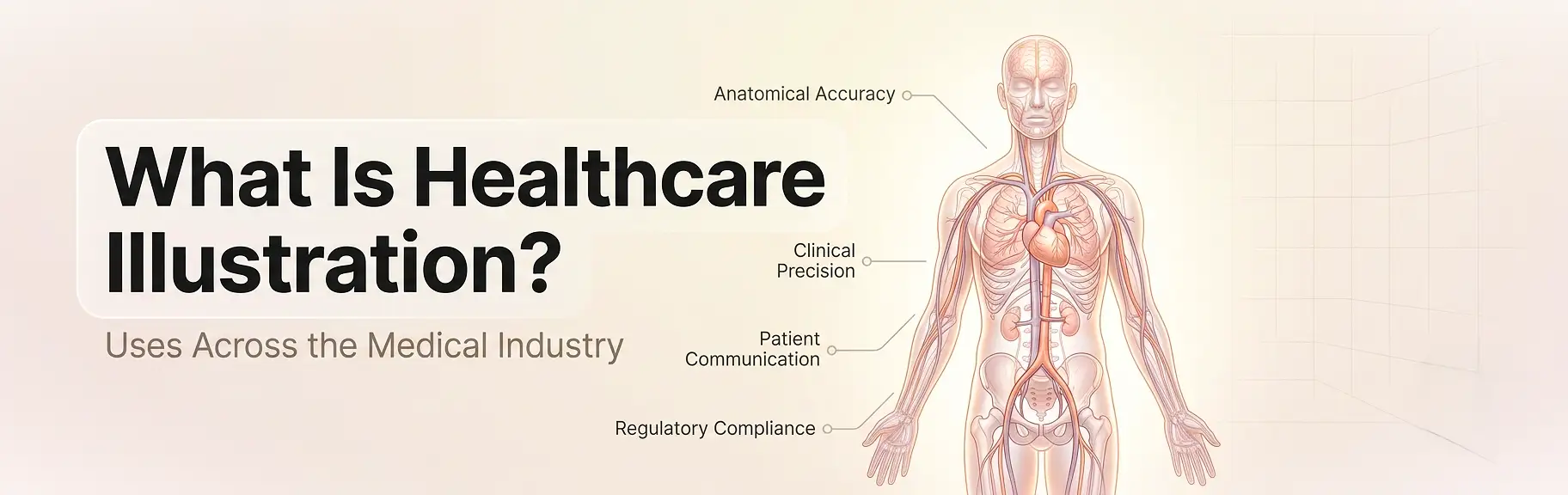
What is Healthcare Illustration? The Core Definition
Healthcare illustration is the practice of creating scientifically accurate visual representations of biological, anatomical, physiological, surgical, or medical-device-related subject matter. Its practitioners – known as medical illustrators or biomedical visualization specialists – combine graduate-level training in both the life sciences and visual communication to produce content that is simultaneously medically accurate and visually intelligible.
According to the Association of Medical Illustrators (AMI), Certified Medical Illustrators (CMIs) must demonstrate mastery of biomedical science, drawing technique, business ethics, and digital production tools. This dual expertise is what separates a healthcare illustration from a generic diagram or stock graphic.
In a single phrase: Healthcare illustration makes the invisible visible, and the complex, comprehensible.
How Healthcare Illustration Differs from General Illustration
Not all medical-looking visuals qualify as true healthcare illustration. The key distinctions include:
- Scientific accuracy: Every anatomical structure, proportion, tissue plane, and pathological change must be clinically verified.
- Purpose-driven design: The visual is engineered to serve a specific communicative goal – teaching a procedure, explaining a condition, or supporting a legal argument.
- Audience calibration: Content is tailored to the knowledge level of the intended audience, whether that is a board-certified surgeon or a first-time patient.
- Regulatory compliance: Illustrations used in pharmaceutical marketing, device labeling, or clinical trials must meet relevant industry and regulatory standards.
General commercial illustration prioritizes aesthetics over accuracy. Healthcare illustration never sacrifices one for the other.
A Brief History: From Cave Walls to 3D Rendering
Healthcare illustration has a remarkably deep history. Long before modern imaging technology existed, visual depictions of the human body served as the primary vehicle for transmitting medical knowledge.
- Ancient civilizations: Egyptians, Greeks, and Romans recorded anatomical knowledge through illustrations on papyrus and stone.
- The Renaissance era: Andreas Vesalius published De Humani Corporis Fabrica in 1543, arguably the first masterwork of rigorous anatomical illustration, combining precise dissection with masterful woodcut engraving.
- The 19th and 20th centuries: Medical illustration became a formal profession, culminating in works like Frank Netter’s Atlas of Human Anatomy, which remains a gold standard in medical education globally.
- The digital era (1990s to present): The shift to digital software brought 3D modeling, interactive surgical simulations, augmented reality overlays, and real-time rendering – allowing healthcare illustrations to be updated, repurposed, and deployed across multiple platforms with unprecedented speed.
As noted in a peer-reviewed study published via PubMed Central (NIH), medical illustrations have served as indispensable educational tools throughout the history of medicine – a role that only deepens as medical knowledge grows more complex.
Today, the discipline encompasses both traditional hand-rendered techniques and advanced digital workflows, making it more versatile than at any previous point in its history.
The Main Types of Healthcare Illustration
Understanding what is healthcare illustration also requires knowing its major formats. Each type serves a distinct purpose and audience. The right choice depends on your project goals, distribution channel, and target viewer.
1. Anatomical Illustration
The foundational category. Anatomical illustrations depict the structure of the human body – its organs, tissues, bones, nerves, vasculature, and musculature – with high precision. They range from full-body systemic overviews to micro-level cellular diagrams.
Common uses: Medical textbooks, anatomy atlases, clinical reference cards, postgraduate medical training.
2. Surgical Illustration
Surgical illustrations document operative procedures step by step. They show incision placement, tissue planes, instrument positioning, suture techniques, and anatomical landmarks at each stage of a procedure.
Common uses: Surgical atlases, operative technique papers, hospital training materials, peer-reviewed journal submissions.
3. Pathological and Diagnostic Illustration
These visuals depict the appearance of diseased, damaged, or abnormal tissues and conditions – both macroscopic and microscopic. They help clinicians recognize, classify, and communicate pathological findings.
Common uses: Pathology textbooks, diagnostic reference guides, laboratory training, oncology education.
4. Medical Device and Product Illustration
Detailed schematics and cutaway views of medical devices, implants, instruments, and equipment. These illustrations are engineered to show how a device functions, how it interacts with anatomy, and how it should be assembled or used.
Common uses: IFU (Instructions For Use) documents, regulatory submissions, sales training, conference presentations, FDA and CE marking dossiers.
5. Patient Education Illustration
Simplified, accessible visuals designed for non-clinical audiences. They depict conditions, treatment options, medication mechanisms, and post-operative care instructions in a format patients can understand and act on.
Common uses: Patient consent forms, hospital discharge packs, health app content, telehealth platforms, public health campaigns.
6. Scientific and Research Illustration
Infographic-level visuals that support academic publication, grant applications, and research communication. These include molecular biology diagrams, cell signaling pathway maps, and clinical trial flowcharts. Common uses: Peer-reviewed journal articles, conference posters, grant proposal visuals, science communication campaigns.
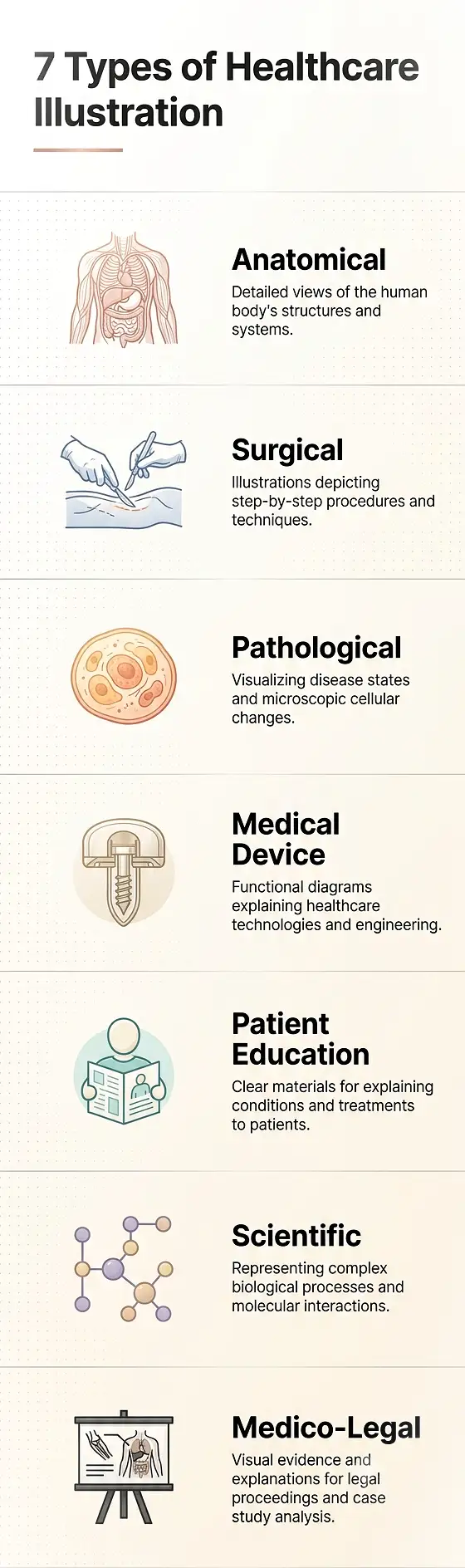
7. Medico-Legal Illustration
Highly precise forensic and injury illustrations created for use in legal proceedings. They depict injuries, surgical interventions, anatomical causation, and biomechanical mechanisms in a format suitable for courtroom presentation.
Common uses: Personal injury litigation, medical malpractice cases, criminal forensic exhibits, insurance dispute documentation.
Comparison Table: Types of Healthcare Illustration at a Glance
| Illustration Type | Primary Audience | Key Output Format | Typical Industry Sector |
|---|---|---|---|
| Anatomical | Medical students, clinicians | Textbook plate, digital atlas | Education, publishing |
| Surgical | Surgeons, surgical trainees | Step-by-step operative diagram | Hospitals, surgical societies |
| Pathological | Pathologists, oncologists | Diagnostic reference visual | Pathology labs, oncology centers |
| Medical Device | Engineers, sales teams, regulators | Cutaway schematic, IFU graphic | MedTech, regulatory affairs |
| Patient Education | Patients, caregivers | Leaflet, app graphic, poster | Hospitals, pharma, health apps |
| Scientific/Research | Researchers, academics | Journal figure, conference poster | Academia, biotech, pharma |
| Medico-Legal | Attorneys, juries, judges | Courtroom exhibit board | Legal, insurance |
| Pharmaceutical/MoA | HCPs, sales reps, marketers | Detail aid, brand asset | Pharma, biotech |
Healthcare Illustration vs. Medical Photography: A Key Comparison
A common question in commissioning circles is: when should you use illustration instead of photography? The answer comes down to control, access, and clarity.
| Factor | Healthcare Illustration | Medical Photography |
|---|---|---|
| Can show internal anatomy | Yes – unlimited depth and layer control | No – limited to surface or imaging scans |
| Can depict future/planned procedures | Yes – shows what will happen | No – documents only what has happened |
| Can isolate specific structures | Yes – other structures removed or faded | No – all structures appear together |
| Regulatory and IP sensitivity | No patient identifiability risk | Risk of patient data and consent issues |
| Adaptability across formats | Easy to resize, recolor, and repurpose | Reshooting required for format changes |
| Accuracy of depiction | Controlled and verified by medical expert | Subject to imaging artifacts and lighting |
| Cost for novel procedures | One-time creation cost | May be impossible to photograph |
For topics like novel surgical techniques, drug mechanisms at a molecular level, or internal device mechanics, healthcare illustration is not just preferable: it is the only viable option.
How Healthcare Illustration Is Used Across the Medical Industry
Now that we have established what healthcare illustration is and its key types, let us explore in detail how each major sector of the medical industry actively uses this discipline.
1. Medical Education and Training
Medical education is, historically, the original and still the most prominent home of healthcare illustration. From the first-year anatomy lab to advanced subspecialty fellowship training, visual learning is irreplaceable.
Research published in a 2025 NIH study on digital medical illustration in faculty development confirms that medical illustration significantly enhances comprehension in the health sciences – and that digital illustration tools remain underutilized relative to their demonstrated educational impact.
Healthcare illustrations serve medical education in several critical ways:
- Anatomy textbooks and atlases: Systematic depictions of every body region, layer by layer, with full labeling.
- Histology and pathology atlases: Microscopic tissue illustrations for recognizing normal and abnormal cellular patterns.
- Surgical technique manuals: Step-by-step operative diagrams that trainees reference before and during procedures.
- CME (Continuing Medical Education) content: Visuals that help practicing clinicians stay current with evolving techniques and evidence.
- Simulation and e-learning modules: Interactive healthcare illustrations embedded in digital learning platforms, including AR and VR surgical training environments.
As the Harvard Medical School Professional Education team notes, the visual dimension of a course is just as critical as the curriculum itself – particularly when teaching complex biomedical concepts to learners at varying levels.
For teams developing training materials at scale, resources on medical illustrations for training videos provide a strong foundation for understanding how illustration integrates into modern e-learning production workflows.
2. Pharmaceutical and Biotech Industry
The pharmaceutical and biotechnology industries are among the heaviest commissioners of professional healthcare illustration. Their needs span the full product lifecycle – from pre-clinical research through post-market brand management.
Mechanism of Action (MOA) Visuals
MOA illustrations are perhaps the most technically demanding form of pharmaceutical healthcare illustration. They depict, at a molecular or cellular level, precisely how a drug compound interacts with its biological target: receptor binding, enzyme inhibition, signal cascade modulation, and downstream cellular effects.
These visuals appear in:
- Medical affairs detail aids used by field medical teams with HCPs (healthcare professionals)
- Launch brand materials for new molecular entities (NMEs)
- Healthcare congress presentations and symposia
- Medical science liaison (MSL) training decks
Regulatory and Clinical Trial Documentation
Pharmaceutical companies use illustration extensively in regulatory submissions. Clinical trial protocols, patient information leaflets (PILs), informed consent documents, and investigator brochures all require clear visual support to meet regulatory expectations from bodies such as the FDA and EMA.
Disease Awareness Campaigns
Patient-facing disease awareness materials – produced for therapeutic areas from oncology and cardiology to rare diseases and neurology – rely on accessible, non-intimidating healthcare illustration to communicate disease burden, treatment rationale, and lifestyle impact.
3. Medical Device and MedTech Companies
Medical device companies have a particularly acute need for high-quality healthcare illustration because their products operate inside the body – making photography of the actual use environment impossible.
Healthcare illustration supports medical device companies across the entire product lifecycle:
Pre-Market and Regulatory:
- Device design verification illustrations for FDA 510(k) and PMA submissions
- Human factors documentation visuals showing user-device interaction
- IFU graphics that must meet ISO 15223 and FDA labeling standards
- Patent application diagrams requiring precise technical accuracy
Sales and Marketing:
- Sales training materials showing device anatomy, deployment mechanics, and competitive differentiation
- Conference booth graphics and congress poster illustrations
- Surgeon education brochures depicting implant positioning and procedural steps
Post-Market:
- Clinical outcomes materials for peer-reviewed publication
- Adverse event documentation visuals for regulatory safety reports
For a deeper look at how illustration intersects with device-level detail and precision, the guide to 3D medical illustration software and workflows explains the technical standards professional studios apply when producing device-grade visuals.
4. Hospitals, Surgical Centers, and Clinical Practice
Within clinical settings, healthcare illustration serves both practitioners and patients – often simultaneously.

For Clinical Teams:
- Operative planning visuals that surgeons use to map incision approaches, anatomical anomalies, and reconstruction strategies for complex cases
- Intraoperative reference diagrams affixed near the surgical field
- Grand rounds and case conference presentation graphics
- Peer-reviewed surgical technique publication figures
For Patients:
- Pre-operative consent illustrations showing what a procedure involves and what anatomical changes will occur
- Post-operative instruction sheets illustrating wound care, mobility restrictions, and recovery milestones
- Chronic disease management visuals – for example, how to self-administer injectable medications, or how to interpret blood glucose patterns
- Mental health and behavioral health educational materials that present complex neurobiological concepts accessibly
Well-designed patient education visuals directly improve outcomes. Patients who clearly understand their diagnosis and treatment plan are more likely to adhere to medication regimens, attend follow-up appointments, and report complications promptly. This is one of the most evidence-supported reasons why medical illustrations matter in modern healthcare delivery.
5. Academic Publishing and Scientific Journals
Scientific and medical journals are perhaps the most quality-critical environment for healthcare illustration. Journal figures must satisfy rigorous peer review standards for accuracy, reproducibility, and visual integrity.
Healthcare illustration appears in academic publishing in several key forms:
- Original research figures: Diagrams of experimental methodology, study design flowcharts, and graphical abstracts for high-impact journals
- Review article visuals: Comprehensive pathway diagrams, meta-analytic forest plots with supporting anatomical context, and disease mechanism summaries
- Case report illustrations: Precise visual documentation of rare or novel clinical presentations
- Textbook chapters: Section-opening illustrations and embedded clinical diagrams
Major journals – including those in the New England Journal of Medicine, The Lancet, and JAMA family – maintain strict author guidelines for figure preparation. Understanding the author guidelines for illustrations in medical and scientific journals is essential for researchers preparing submissions, particularly regarding resolution, color mode, and labeling standards.
Additionally, scientific illustration for open-access publication has grown significantly – particularly for research that targets both specialist and public audiences simultaneously, where visual accessibility matters as much as technical precision.
6. Legal and Forensic Applications
The medico-legal field represents one of the most specialized – and highest-stakes – applications of healthcare illustration. Legal professionals rely on these visuals to communicate complex medical and anatomical facts to lay audiences: juries, judges, and opposing counsel.
Personal Injury Litigation
In personal injury and medical malpractice cases, healthcare illustrations are used as demonstrative evidence exhibits. They depict:
- The nature and extent of injuries sustained
- The anatomical location and severity of trauma
- The surgical procedures performed in response
- Long-term anatomical consequences of the injury
Forensic Pathology
Forensic healthcare illustration supports medical examiners and pathologists in documenting cause of death, wound patterns, and injury mechanics in a format that is clear to non-medical professionals. Research published in peer-reviewed forensic medicine literature confirms that medical-legal illustrations can serve as effective replacements for graphic photographic evidence – improving jury comprehension while reducing emotional distress from raw autopsy imagery.
Insurance and Disability Claims
Insurers and disability adjudicators use illustration to verify injury severity, pre-existing conditions, and the anatomical basis of claimed functional limitations.
Healthcare illustration in legal contexts must balance absolute anatomical accuracy with clarity of presentation – a combination that requires both scientific rigor and exceptional communication design skill.
7. Public Health, Government, and Non-Profit Sector
Healthcare illustration plays a critical role in population-level health communication. Government agencies, international health organizations, and non-profit health advocates all rely on illustration to:
- Communicate vaccination schedules and mechanisms to general populations
- Explain pandemic disease transmission routes and prevention behaviors
- Support maternal and child health literacy programs
- Produce multilingual health education materials where illustration transcends language barriers
- Illustrate nutrition guidance, screening schedules, and chronic disease self-management programs
During the COVID-19 pandemic, illustrated infographics from organizations like the WHO and CDC became the primary public-facing tools for explaining viral transmission, mask efficacy, and vaccine mechanisms – demonstrating the unique power of healthcare illustration to inform and reassure populations under acute pressure.
The Relationship Between 2D and 3D Healthcare Illustration
One of the most significant developments in modern healthcare illustration is the expansion of 3D rendering capabilities. Understanding the distinction between 2D and 3D helps commissioners choose the right format for their specific needs.
2D Healthcare Illustration
Traditional 2D illustration – produced digitally in vector or raster formats – remains the industry standard for many applications. It offers:
- Precise, clean linework ideal for print and publication
- Easy labeling and annotation
- Lightweight file formats suitable for digital distribution
- A clear, diagram-like aesthetic that many clinical audiences find immediately legible
For journal submissions, textbook plates, and patient education leaflets, 2D illustration is often the optimal and most cost-effective choice. File format decisions – such as whether to deliver vector EPS, layered PDF, or high-resolution TIFF – are determined by the specific output requirements defined in the project brief.
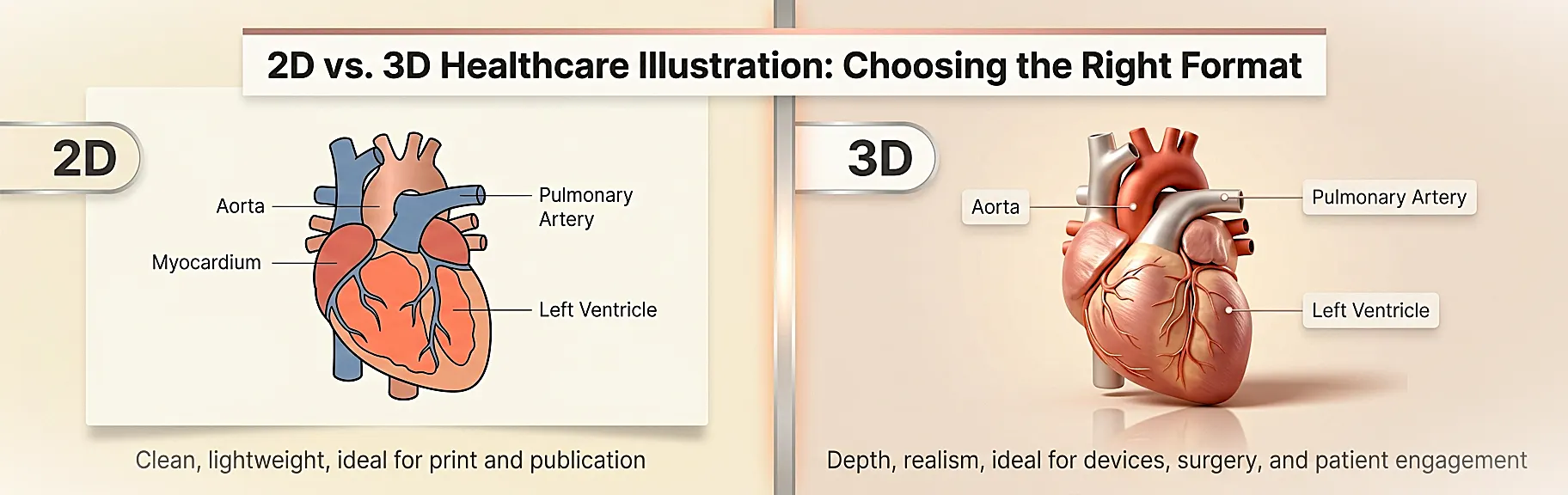
3D Healthcare Illustration
Three-dimensional rendered healthcare illustration adds depth, surface texture, lighting, and spatial realism that 2D cannot achieve. It is particularly powerful for:
- Medical device illustrations showing internal mechanisms and spatial relationships
- Surgical planning visuals that replicate the intraoperative perspective
- Patient-facing content where photorealism improves engagement and comprehension
- Augmented and virtual reality medical training content
- Pharmaceutical MOA sequences that benefit from molecular spatial modeling
For a comprehensive breakdown of what makes 3D medical visuals different – and when they are worth the additional investment – the deep-dive resource on what 3D medical illustration actually involves covers the technical and creative process in full detail.
Key Industries That Commission Healthcare Illustration: At a Glance
| Benefit | Traditional Blueprint Process | With 3D Exterior Rendering |
|---|---|---|
| Design clarity | Low – requires technical literacy | High – photorealistic output anyone can assess |
| Material preview | Sample boards only | Full-scale digital simulation |
| Change cost timing | Expensive if post-construction | Free or low-cost during rendering revision |
| Stakeholder communication | Abstract and open to misinterpretation | Shared visual reference eliminates ambiguity |
| Permit and HOA approval support | Limited visual aids available | Professional-grade images available for submission |
| Emotional confidence before building | Low – reliant on imagination | High – evidence-based decision-making |
What Makes a Great Healthcare Illustration? Expert Insights
Not every medical-looking image qualifies as a high-quality healthcare illustration. Commissioning teams – whether in a pharmaceutical medical affairs department, a hospital communications team, or an academic publishing house – should evaluate potential illustration work against the following professional standards.
1. Scientific and Anatomical Accuracy
The most fundamental criterion. Every structure depicted must be correctly identified, proportioned, and positioned relative to its anatomical context. Errors in healthcare illustration can propagate misinformation through thousands of students, patients, or practitioners.
Professional studios employ subject-matter expert (SME) review at multiple stages of the illustration workflow – typically involving a clinician or scientist who validates accuracy before a visual is finalized.
2. Clarity of Communication
Technical accuracy means nothing if the illustration confuses its audience. Skilled healthcare illustrators manage visual hierarchy – guiding the viewer’s eye to the most clinically important element first, using color, contrast, labeling, and composition.
3. Appropriate Style for the Audience
A surgical atlas illustration for consultant surgeons looks very different from a patient-facing leaflet illustration for someone newly diagnosed with diabetes. Style – including level of detail, color palette, and visual language – must match the intended reader’s background and emotional context.
4. File Format and Technical Compliance
For publication, illustrations must meet specific resolution, color profile (CMYK vs. RGB), and file format requirements. For regulatory submissions, they must comply with FDA, EMA, or ISO labeling standards. For digital deployment, they must be optimized for screen display without loss of quality.
5. Scalability and Repurposing Potential
High-value healthcare illustrations are built as layered, vector-based assets that can be adapted for multiple formats – print, web, presentation, video – without the cost of recreating them from scratch.
Common Mistakes When Commissioning Healthcare Illustration
Even experienced medical marketing and communications teams make avoidable errors when commissioning healthcare illustration projects. Here are the most frequent pitfalls – and how to sidestep each one.
Mistake 1: Choosing Stock Art Over Custom Illustration
Generic stock medical images are rarely accurate enough for clinical or regulatory use. They are built for visual appeal, not anatomical precision. For most professional applications, custom healthcare illustration is the correct – and ultimately more cost-efficient – choice.
Mistake 2: Skipping the Medical Review Stage
Illustrations that are not reviewed by a qualified clinician or scientist before delivery carry a significant accuracy risk. Always ensure your studio includes an SME review checkpoint in the production workflow.
Mistake 3: Specifying the Wrong File Format
Requesting a low-resolution JPEG for a print journal submission – or a print-spec TIFF for a mobile health app – creates costly rework. Define output requirements at the brief stage: resolution, file type, color mode, and intended distribution channel.
Mistake 4: Underestimating the Briefing Process
The quality of the output is directly proportional to the quality of the brief. Vague requests like “show a heart surgery” produce generic results. Effective briefs specify the exact anatomical view, the procedure step to be depicted, the labeling required, and the primary audience.
Mistake 5: Ignoring Regulatory Requirements
For pharmaceutical, device, or clinical trial materials, illustrations may be subject to regulatory scrutiny. Working with a studio that understands FDA, EMA, and ISO visual communication standards from the outset prevents costly revisions at submission stage.
Mistake 6: Treating Illustration as an Afterthought
The most impactful healthcare illustration is developed in parallel with content strategy – not appended as a last-minute visual decoration. Brief your illustration studio at the same time as your medical writer, not after the text is finalized.
How the Healthcare Illustration Process Works: Step by Step
Understanding the production workflow helps commissioners set realistic timelines, structure their briefs effectively, and collaborate productively with their illustration studio.
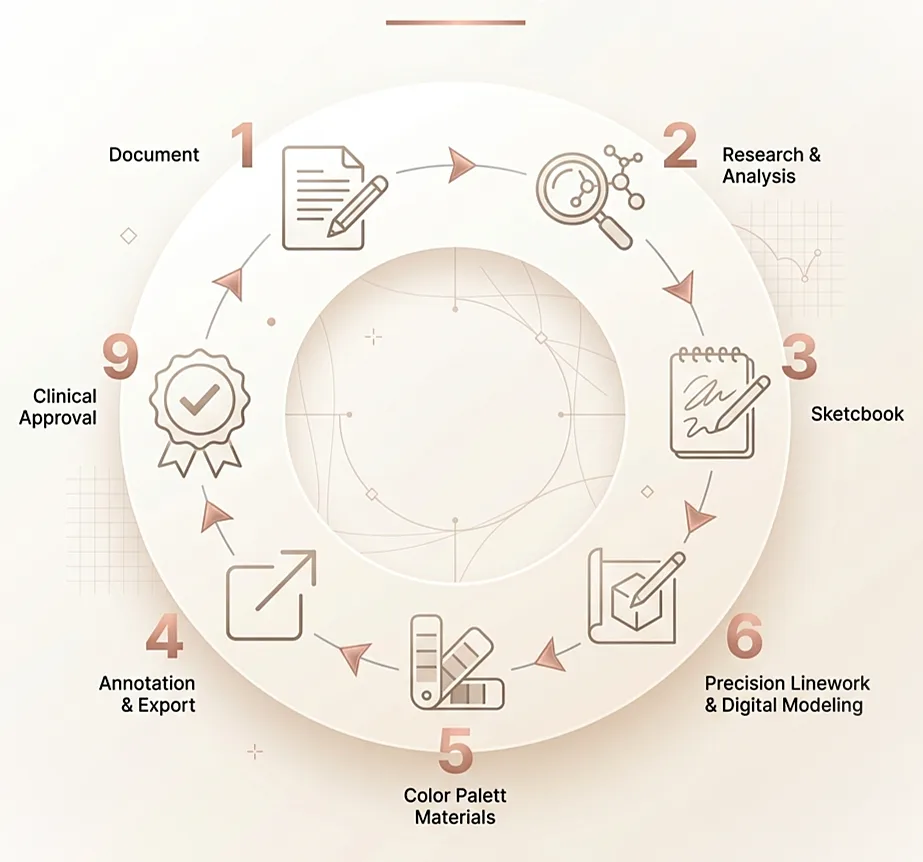
Step 1: Define the Brief Specify the subject matter, anatomical or clinical scope, intended audience, output formats, style direction, and any regulatory considerations. The more precise the brief, the more accurate – and efficient – the creative process.
Step 2: Reference and Research The illustrator gathers scientific reference materials: published anatomy texts, medical imaging (CT/MRI/histology), peer-reviewed literature, and consultation with clinical SMEs. This stage ensures every subsequent artistic decision is grounded in verified science.
Step 3: Initial Concept Sketches Rough compositional sketches are developed to establish viewpoint, anatomical focus, and visual hierarchy. These are shared with the client for directional approval before detailed work begins.
Step 4: Detailed Line Art or 3D Base Model For 2D projects, refined linework is produced digitally. For 3D projects, base geometry is modeled and positioned. At this stage, anatomical accuracy is confirmed by SME review.
Step 5: Color, Texture, and Rendering Color palettes are applied, tissue textures are rendered, and lighting conditions are established to achieve the target visual style – whether that is a clinical textbook look, a photorealistic surgical perspective, or a simplified patient-friendly schematic.
Step 6: Labeling, Annotation, and Finalization Text labels, callout lines, scale bars, and any required regulatory symbols are added. Final art is exported in all specified formats and resolutions.
Step 7: SME Final Review and Approval Before delivery, the completed illustration undergoes a final accuracy review. Any corrections are applied and the file is delivered to the client with full usage rights documentation.
Healthcare Illustration in the Age of AI: What Changes and What Does Not
The rapid rise of AI-generated imagery has prompted many organizations to ask whether AI tools can replace professional healthcare illustration. The honest answer is: not for most professional use cases.
AI image generation tools produce visually plausible content – but they cannot guarantee anatomical accuracy, clinical specificity, or regulatory compliance. They have no understanding of the clinical context behind an image, no ability to verify that a depicted surgical approach is evidence-based, and no capacity to fulfill subject-matter expert review requirements.
A peer-reviewed 2025 NIH paper examining AI-generated visual art in medical education acknowledges the potential benefits of AI visuals for general educational content, while clearly noting the significant challenges around accuracy, bias, and quality assurance in clinical contexts.
Professional healthcare illustration studios bring capabilities that AI cannot currently replicate:
- Graduate-level biomedical and artistic training
- Clinician-reviewed production workflows
- Regulatory submission experience
- Legally defensible accuracy for medico-legal use
- Institutional accountability and professional indemnity
AI tools may support early-stage ideation or produce generic health communication graphics. However, for anything requiring precision – surgical atlases, pharmaceutical regulatory documents, medical device IFUs, or legal exhibits – professionally produced healthcare illustration remains irreplaceable.
Expert Tips: Getting the Best Results from Healthcare Illustration
Whether you are commissioning your first illustration project or refining an established workflow, these expert tips will help you achieve the highest-quality outcomes.
Tip 1: Involve a Clinician in the Brief The single biggest quality differentiator is having a relevant clinical specialist contribute to – or review – the brief before production begins. This reduces inaccuracy risk and minimizes costly revisions.
Tip 2: Request Layered Source Files Always ask for layered source files (Adobe Illustrator, Photoshop, or equivalent) in addition to final export formats. This allows you to update labels, add new elements, or repurpose illustrations for future projects without starting from scratch.
Tip 3: Plan for Multi-Format Deployment Early If your illustration will appear in both a print journal and a mobile app, brief the illustrator for both from the start. Retrofitting print art for digital use – or vice versa – frequently degrades quality and adds avoidable cost.
Tip 4: Use a Visual Style Guide For organizations that commission illustration regularly, a visual style guide ensures consistency across all materials. This includes preferred color palettes, labeling conventions, tissue color standards, and typography.
Tip 5: Build in Review Cycles Allow time for at least two rounds of revision in your project timeline. Rushing the review process is the most common source of accuracy errors reaching final output.
Tip 6: Clarify Usage Rights from the Outset Exclusive rights mean only your organization can use the illustration. Non-exclusive rights allow the studio to license the same work to others. For regulated or commercially sensitive materials, exclusive rights are almost always the correct investment.
Frequently Asked Questions About Healthcare Illustration
What is healthcare illustration, exactly?
Healthcare illustration is a specialized professional discipline in which artists with graduate-level training in both biomedical science and visual communication create anatomically accurate, clinically verified graphic content. This content is used across the medical industry for education, training, pharmaceutical marketing, patient communication, research publication, medical device documentation, legal proceedings, and public health communication.
How is healthcare illustration different from medical illustration?
The two terms are largely interchangeable in professional usage. “Medical illustration” is the older, more traditional term used within the discipline’s professional bodies – such as the Association of Medical Illustrators (AMI) and the Institute of Medical Illustrators (IMI). “Healthcare illustration” is a broader term that encompasses the full spectrum of visual content produced for healthcare settings, including clinical photography, health infographics, and digital health interface design. For practical purposes, both terms refer to the same core discipline of scientifically accurate visual medical communication.
Who creates professional healthcare illustrations?
Healthcare illustrations are created by medical illustrators – professionals who typically hold graduate degrees from accredited programs in medical and biological illustration (such as those offered at Johns Hopkins University, the University of Toronto, or Augusta University). Certified Medical Illustrators (CMIs) have passed a rigorous credentialing examination administered by the Board of Certification of Medical Illustrators (BCMI). Many professional medical illustrators also hold memberships in the AMI or IMI.
How long does a healthcare illustration project take?
Project timelines vary significantly based on complexity, number of illustrations, and the number of revision cycles. A single simple 2D diagram may require one to two weeks. A complex 3D surgical sequence or full-chapter anatomical atlas section may